
Catalog
Novels, short stories, nonfiction, and more with a primary or significant queer theme.
The light that reveals us to ourselves is always inconvenient. But having once stood in it, we can’t walk in the shadow without misgivings.
André Tellier, Twilight Men (1931)

- Show All
- Availability
-
Intersex
-
Read Now
-
No Text Online
- Sexuality
-
Gay Men
-
Lesbian
-
Bisexual
-
Transgender
- Year
-
1880s
-
1890s
-
1900s
-
1910s
-
1920s
-
1930s
- Pages
-
001+
-
050+
-
100+
-
150+
-
200+
-
250+
-
300+
-
400+
-
350+
-
600+
About:
A autobiographical novel set in Oxford. Many characters were Warren’s contemporaries, such as John Addington Symonds and Walter Pater.
Written by Edward Perry Warren as Arthur Lyon Raile. Although written in the 1880’s it was first published in 1927.
Editions
- London : Cayme Press (1927). A red cloth-bound book with gilt text on spine of title only, no author or press. Seen at Elysium Books.
- Masaryk University Press (2014) in The Collected Works & Commissioned Biography of Edward Perry Warren: Volume I by Michael Kaylor (ISBN: 978-8021063457)
Also see
- The Collected Works & Commissioned Biography of Edward Perry Warren: Volume I (2014) by Michael Kaylor
- The Mount Vernon Street Warrens: A Boston Story, 1860-1910 (1989) By Martin Green. New York : Charles Scribner’s Sons.
Author Details:
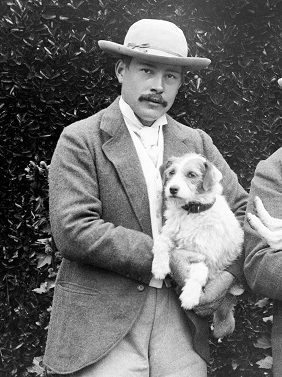
About:
An autobiographical novel of Kurt Gray, a composer and pianist, from his lonely sexual awakening to a successful, partnered peace in adulthood. He grew up in Michigan with protective but misunderstanding parents, a long list of bullies, and few friends. The discovery of masturbation—and his minor sexual dalliances with other boys—fill Kurt with an extreme guilt only augmented by the Methodist church.
When he leaves for university, he lives with Chloe and Derry Grayling, becoming good friends with the first and the lover of the second. But to Kurt, Derry’s love is inadequate and nonintellectual. After Kurt’s post-grad move to New York, Derry finds a second lover in David Perrier: a clever, dandy-like man with a guarded insecurity. Kurt rebuffs the new man at first, then tumbles into a polygamous romance between the three of them.
Nevertheless, Chloe loves Kurt even after he confesses his homosexuality to her. She reports that while he is in Europe on a music scholarship, Derry and David have opened their relationship to a crowd of other men in Greenwich Village. Kurt maintains that sex ought to be an exclusively loving act, and, disillusioned in his love, finds comfort in a new friend, Tony McGuaran.
Although gay, Tony sleeps with men and women invariably for fun. He attempts to guide Kurt into a matching cynicism, proving his point with knowledge of David’s secret history. The “guardian” that David once professed to is actually a sugar daddy and the host of lurid homosexual orgies. Nevertheless, upon returning to New York, Kurt falls once more in love with David, who confesses a regret for his past. Kurt goes on to secure a position as a music teacher in Connecticut, where he manages to console and mentor a gay teenager. David still lives in New York while writing a book about queer lives, and Derry gets arrested after a police officer entraps him into promising a sex liaison. With his job, Kurt has enough money to pay for the charges for Derry’s innocence, then thinks to use his money to secure a home nearby the school to live with David in.
He returns to New York to tell David to come live with him, but finds that David had left that night to meet with his former sugar daddy. Betrayed, Kurt turns to Chloe for sex, and emerges from the disappointing experience with a deeper trust in David. At the novel’s close, he reunites with David for their future life together.
Editions
- New York : Greenberg (1933) first edition.
- Universal Publishing and Distributing Corp. (1951) as Torment. 159pp.
- Alyson Publications (1987) with introduction by Hubert Kennedy. 284pp. 978-1555831165.
- Boston : Alyson Publications, Inc. (1990) with introduction by Hubert Kennedy and epilogue by Forman Brown. ISBN 1-55583-116-8.
- Alyson Books (1995) with author credited as Forman Brown. Includes epilogue and photographs of Brown. 222pp. 978-1555832841. Reissued in 2000 as 978-1555835736.
- Los Angeles Public Library (2020) with author credited as Forman Brown. Foreword by John F. Szabo. 283pp. 978-1734671315.
Also See:
- Clarke, Kim. “Blue Angel.” University of Michigan Heritage Project.
- Beyelia, Nicholas. “The Lost Novel of Forman Brown.” LAPL Blog, 25 June 2021.
Read Now:
About:
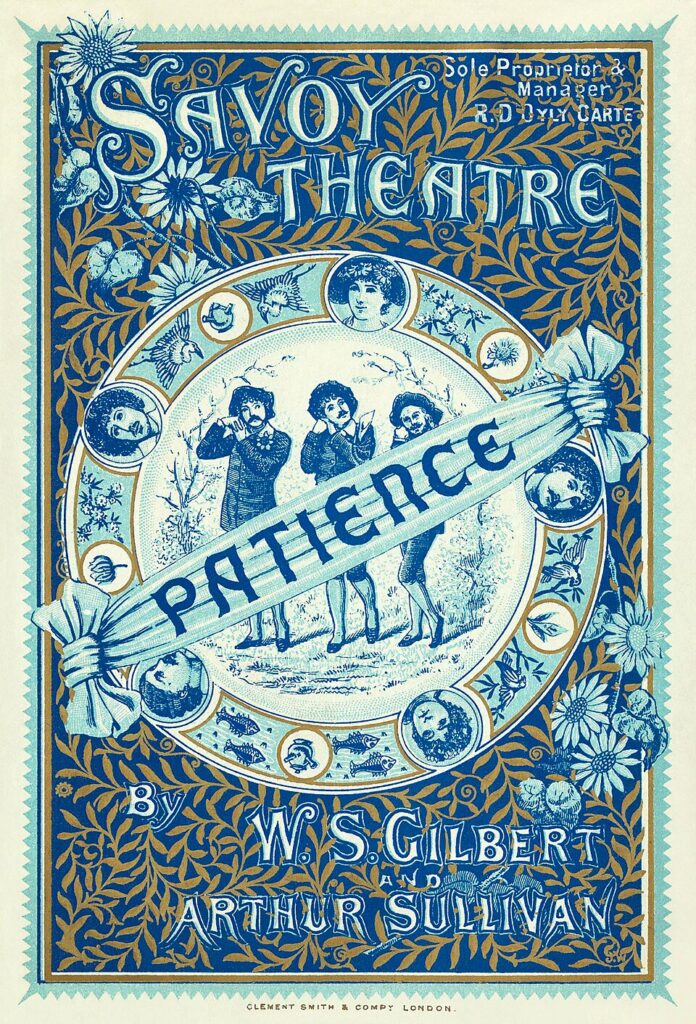
An opera satire of the aesthetic movement, particularly inspired by the Pre-Raphaelites. Involves the jealousies of other men for Bunthorne, an aesthetic poet, who has enthralled their fiances with his art. They bicker over who he is to marry; he marries no one.
First performed at the Opera Comique, London, on April 23, 1881.
Occasionally subtitled or named Bunthorne’s Bride.
Read Now:
About:
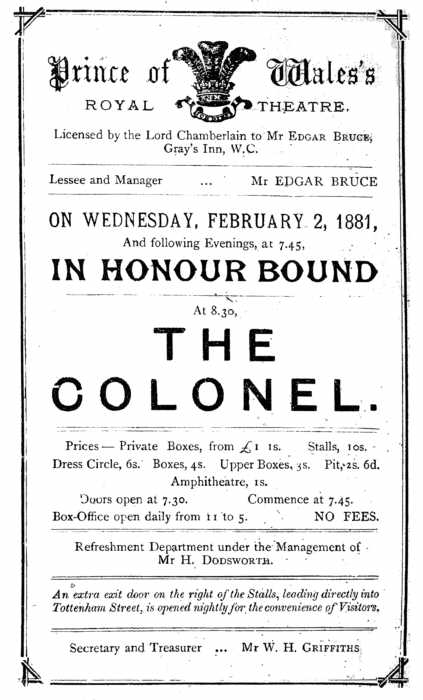
An comedy satire of the aesthetic movement, particularly inspired by the Pre-Raphaelites and based on the play Le Mari à la Campagne (1844). Two aesthetes attempt to convert a man’s wife and mother-in-law to Aestheticism to inherit their fortune; the man’s friend, the Colonel, attempts to restore order.
First performed at the Prince of Wales’s Theatre on February 2, 1881.
More information is available at the The Nineteenth-Century Marteau.
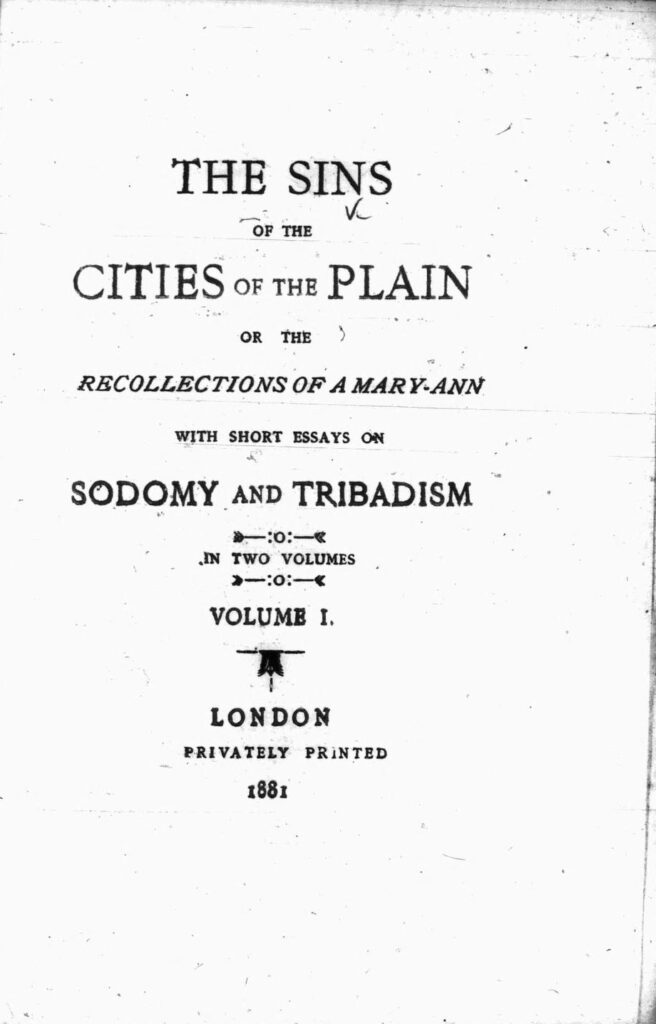
About:
subtitled The Recollections of a Mary-Ann, with Short Essays on Sodomy and Tribadism. A series of sexual vignettes based on the life (or imagination) of Jack Saul, a cross-dressing sex worker.
Authorship of the book is contested between at least three figures: the original Jack Saul, James Campbell Reddie (an erotica writer and bibliographer who often contributed to Lazenby), and Simeon Solomon (a Pre-Raphaelite and illustrator of Swineburne’s unpublished erotica).
Editions
- London: William Lazenby (1881) first edition title page from Project Gutenberg. Privately printed in 250 copies.
- Masquerade Books (1992) paperback edition is a rewritten version of the text. Excises or ages-up underage scenes, extends other sex scenes, changes all heterosexual sex into homosexual, and adds more. It expands the book with approximately 30% more text.
Also see:
- The Sins of Jack Saul – The True Story of Dublin Jack and the Cleveland Street Scandal (2016) by Glenn Chandler. Grosvenor House Publishing Limited. (ISBN: 978-1781489918)
- “ANONYMOUS and Badboy Books: a 1990s moment in the history of pornography” (2016) by Barry Reay and Nina Attwood
Content & Trigger Warnings
Read Now:
About:
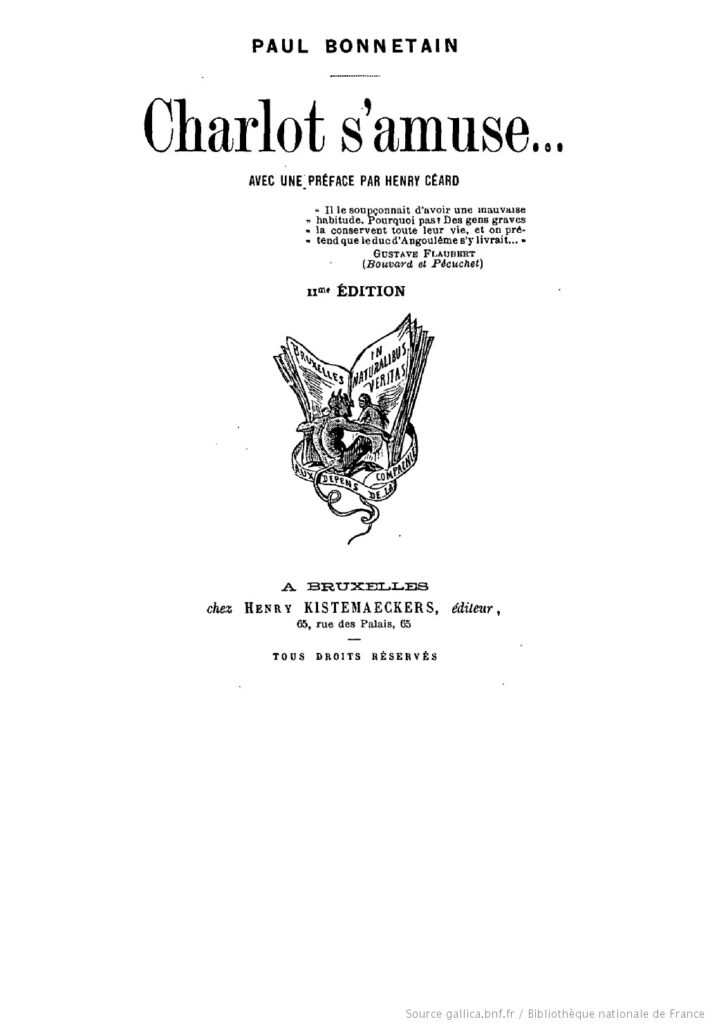
A novel of a compulsive masturbator. Charlot, the son of sex worker and an alcoholic, discovers masturbation after his father’s funeral. He is sent to a Catholic order and school pervaded by homosexuality. When he graduates into the army, his interest shifts to women, and he attempts a disastrous marriage which ends in his suicide.
A hugely scandalous and popular book that flew through about five reprints in two weeks. Bonnetain was sued for the book but acquitted in late 1884; editions after 1885 are expanded with further details of the trial.
Editions
- Bruxelles : Henrey Kistmaeckers (1883)
- Bruxelles : Henrey Kistmaeckers (1885) Edition augmented with a document relating to the trial judged by the Court of Assizes of Paris on December 27, 1884, and an opinion of the author.
Also see:
- “The Charlot s’amuse trial: onanism and the scandal of naturalist fiction” by Marco Wan in Masculinity and the Trials of Modern Fiction (2016). Routledge. (ISBN: 9781315544083)
- “Les Ensablés – ‘Charlot s’amuse” de Paul Bonnetain (1858-1899): une curiosité naturaliste.” (2014) by Herve Bel
Content & Trigger Warnings
ALCOHOLISM: The father of the protagonist is an alcoholic.
CHILD ABUSE: The protagonist’s mother and a friar beats him.
DOMESTIC ABUSE: A man who sleeps with the protagonist’s mother beats her.
RAPE: The protagonist is raped by an older friar. The protagonist contemplates raping girls.
SUICIDE: The protagonists commits suicide at the end of the novel.
About:
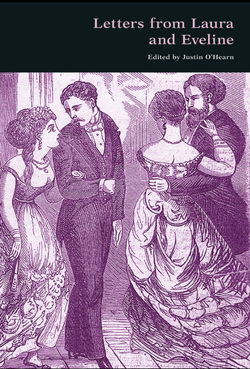
Laura and Eveline, a pair of cross-dressing sex workers mentioned in The Sins of the Cities of the Plain (1881), hold an orgy in celebration of their wedding.
Subtitled Giving an account of their Mock-Marriage,Wedding Trip, etc.
William Lazenby, the original publisher for The Sins of the Cities of the Plain (1881) was cited as the author of the text in Classics in Extremis: The Edges of Classical Reception (2018) edited by Edmund Richardson. Bloomsbury Publishing.
Editions
- London : Charles Hirsch (1883) reprinted in 1889 and 1903.
- Richmond, Virginia : Valancourt Books (2013) ed. by Justin O’Hearn. 92p. Contains the text from the only copy known to have survived: the 1903 edition held by the British Library.
Also see:
- Valancourt Books’s outline of Justin O’Hearn’s 2013 edited edition.
- LGBT Victorians: Sexuality and Gender in the Nineteenth-century Archives (2022) by Simon Joyce. Oxford University Press.
- From Sins of the Cities of the Plain to Letters from Laura and Eveline: Boulton, Park, and Pornography’s Reaction to Transmisogyny (2024) by Daniel Falco.
About:
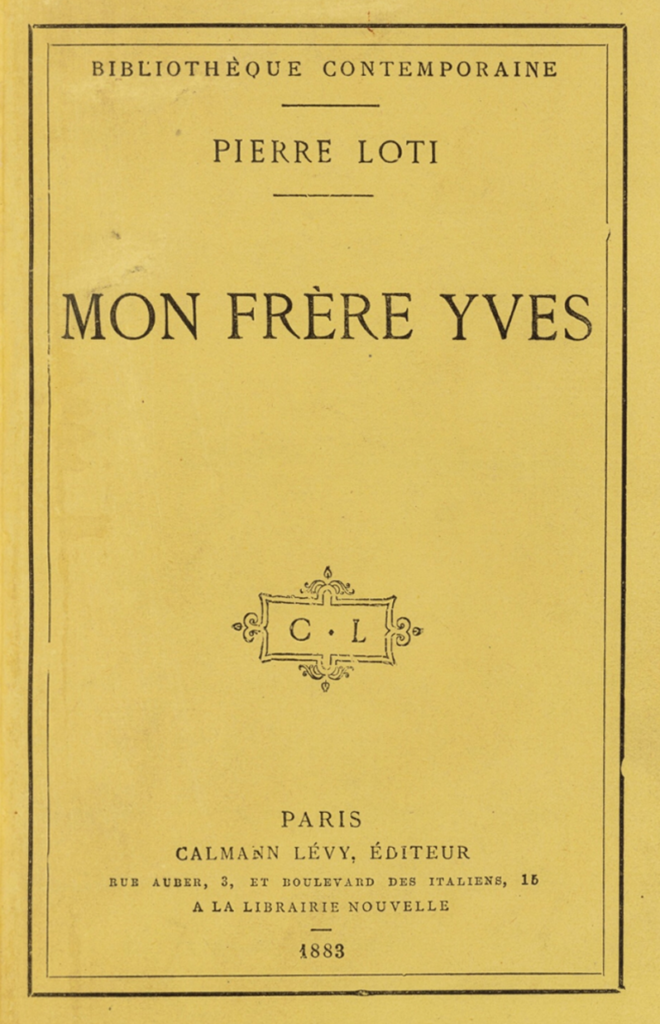
A semi-autobiographical novel of Loti’s time as a French naval officer. The character of the alcoholic Breton sailor, Yves Kermade, was based on Pierre le Cor, a man with whom Loti sailed in the 1870s.
My Brother Yves in English.
Several key passages in Proust’s Remembrance of Things Past/In Search of Lost Time were inspired by Mon Frere Yves.
Wikipedia cites that the book is not homoerotic but Loti, who has written several other homoerotic books such as Aziyadé (1879), claimed otherwise.
Editions
- Paris : Calmann Lévy (1883) 20 copies on Holland paper, one seen at Sothebys.
- London : Vizetelly & Company (1887) as My Brother Yves. English tr. Mary P. Fletcher. 240pp.
- New York : Frederick A. Stokes (1900) as A Tale of Brittany. English tr. W.P. Baines. 301pp. DJ cover seen at Columbia Books on Abebooks.
- London : T. Werner Laurie, Ltd (1928) as A Tale of Brittany. 301pp. with colored plates by Mortimer Menpes. DJ cover seen at Boundless Bookstore on Abebooks.
- Rosedog Press (2004) as My Brother Yves. English tr. John LeVay. 236pp.
Also see:
- “Portraying male same-sex desire in nineteenth-century French literature: Pierre Loti’s Aziyadé” (1998) by Richard M. Berrong
- In Love with a Handsome Sailor: The Emergence of Gay Identity and the Novels of Pierre Loti (2003) by Richard M. Berrong
- Sex, Sailors and Colonies: Narratives of Ambiguity in the Works of Pierre Loti (2005) by Hélène de Burgh
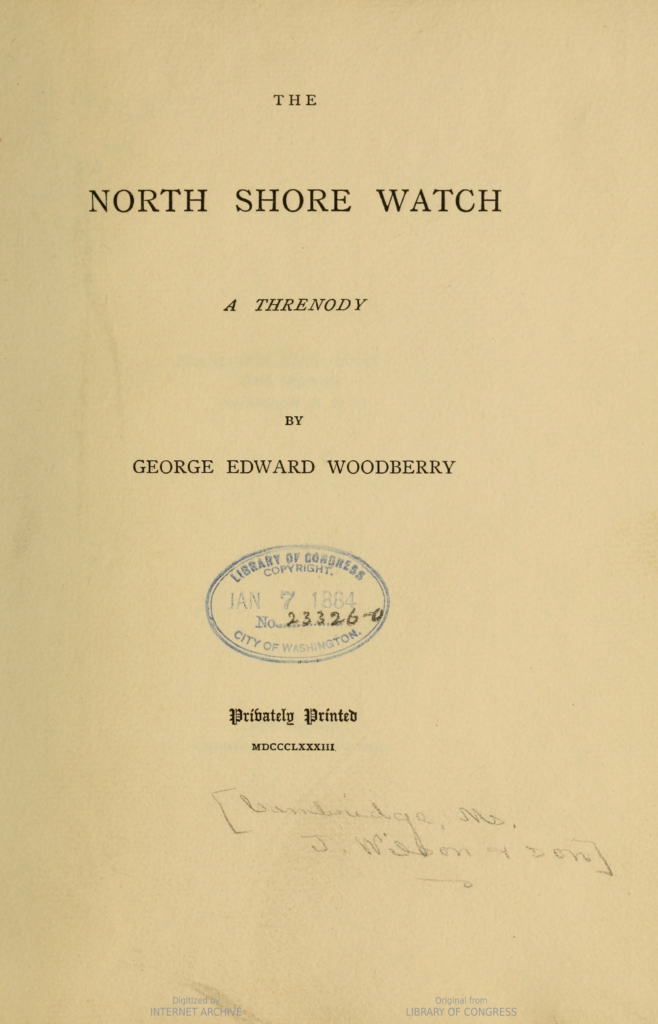
About:
A single threnody poem in forty-seven parts.
In memory of Clarence Laighton Dennett.
Expanded in 1890 with 17 additional poems.
Editions
- Cambridge : John Wilson and Son, University Press. (1883) Privately Printed in 200 copies.
- Cambridge: The Riverside Press (1890) 122pp. 17 additional poems.
- Boston : Houghton, Mifflin, and Company. (1890) 122pp. 17 additional poems.
Also see
- The Overland Monthly (1890) 429p. A review for the book as “Verse of the Year.”
- The Book News Monthly (1904) Vol 22, 681p. Short biography of Woodberry.
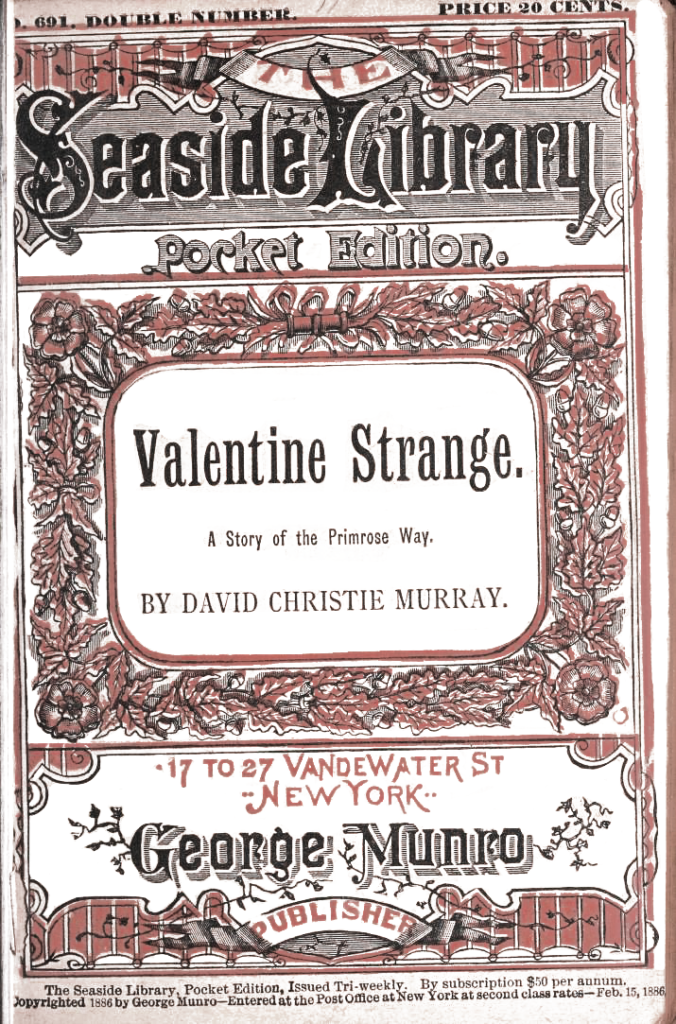
About:
Though Gerard Lumby falls in love with the violet-eyed Constance, so does Valentine Strange—an idle, rich man with dreams of sailing around the world. Their friendship is tested by their love rivalry, which eventually ends in Strange’s betrayal and doomed elopement with Constance.
A book listed as queer in Edward Prime-Stevenson’s short story, “Out of the Sun,” published in Her Enemy, Some Friends, and Other Personages.
Editions
- Chamber’s Journals (Jan 7-Dec 30 1882). Original serialization. Page numbers found on Victorian Fiction Research Guides.
- London : Chatto and Windus (1883) subtitled as a “New Edition.” Released in three volumes: one, two, and three. They also released an omnibus in the same year and in 1889.
- London: Chatto and Windus (1885) as a Yellowback text. Seen at the The Athenaeum of Philadelphia’s Yellowbook site.
- New York : George Munro (1886) as Valentine Strange: A Story of the Primrose Way. Pocket Edition.
Content & Trigger Warnings
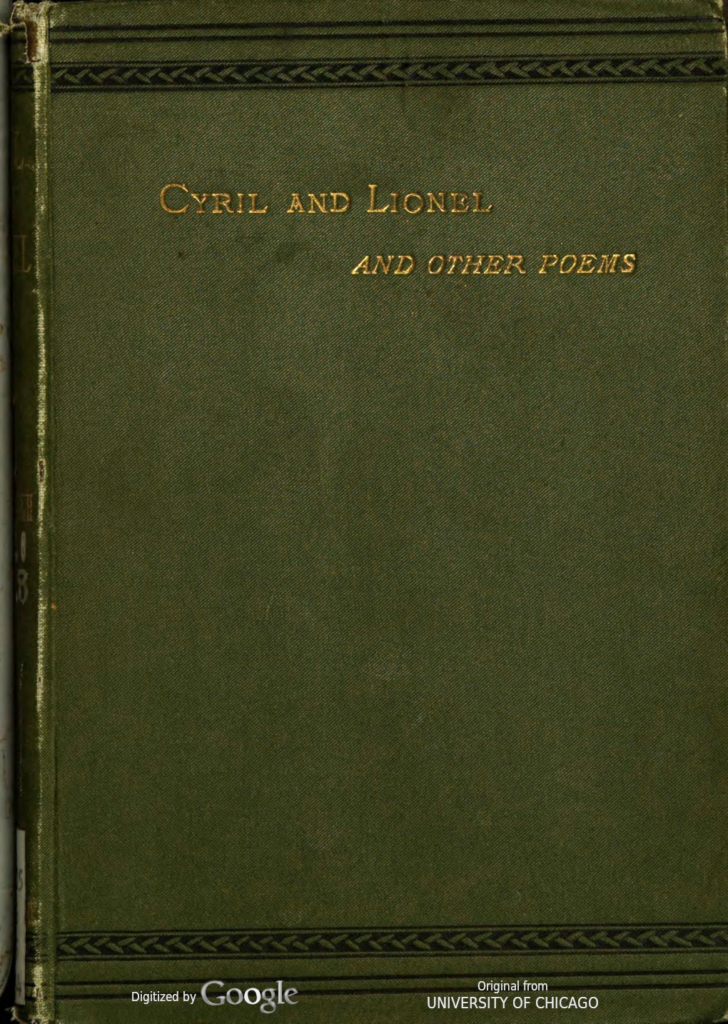
Read Now:
About:
Fifteen poems, mostly queer and several in French.
Highlights: “Shame and Beauty“, “Les Aveux Du Silence“, “To The Best Beloved“, “Love and Weariness,” “Passion.”
Editions
- London : Keagan Paul, Trench & Co. (1884) first edition cover. Cover and spine also seen at Jarndyce Antiquarian Booksellers.
Also see:
- “Say It with Flowers: The Poetry of Marc-André Raffalovich” (1997) by Ed Madden
- “Discovery of books from the library of Oscar Wilde” (2016) by Gerald Cloud for pictures of Wilde’s copy.
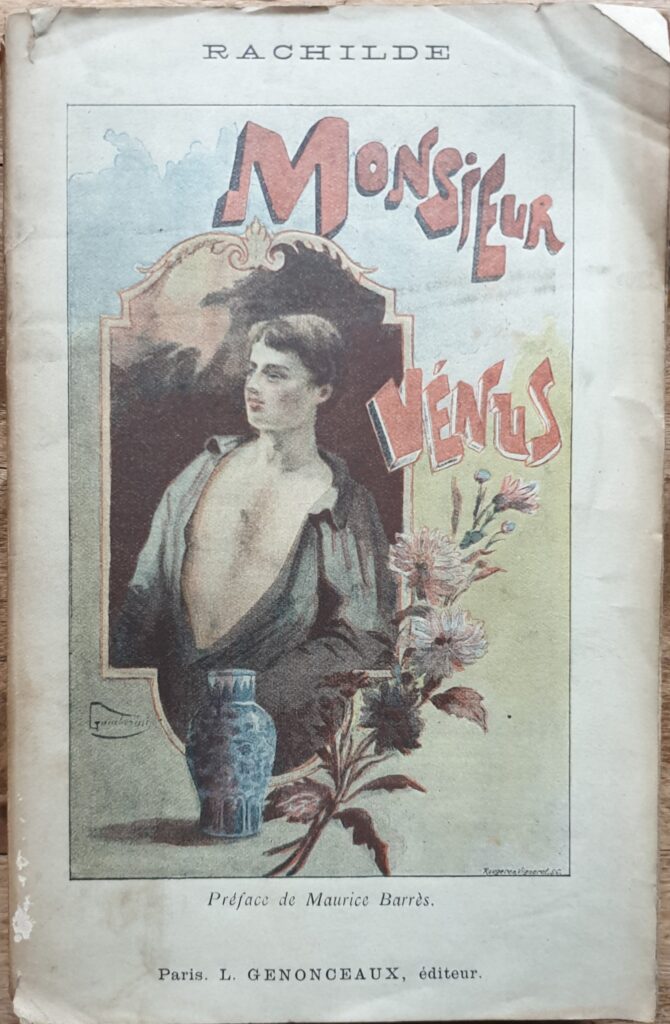
About:
A novel of a woman bored of her life and who pays a poor florist to enter a relationship with her. She taunts and abuses him from an androgynous figure into a feminine one, but when he tries to seduce her rejected male suitor, she organizes a duel which leaves the florist dead. By the end, in interchanging male and female clothes, she embraces a wax doll created to mimic the dead man.
Editions
- Bruxelles : August Brancart (1884) first edition contains the full text. A fictitious co-author named “F. T.” is also credited.
- Bruxelles : August Brancart (1884) second edition contains a few deleted words in the final chapter. Contains a preface by Arsène Houssaye. Seen at Livres-émoi on Abebooks.
- Bruxelles : August Brancart (1884) third edition contains further excisions, cutting erotic details in the final chapter and the protagonist’s orgasm from a daydream in Chapter 2.
- Paris : Felix Brossier (1889) first edition published in France. Contains all excisions from previous publications plus further cuts, including Chapter 7, where the protagonist asserts that women could destroy men by robbing them of their masculinity through sex. Francis Talman’s name as collaborator is also removed. Contains an editor’s note and a preface by Maurice Barrès.
- New York : Covici, Friede (1929) first English Edition in 1,200 copies. Translated by Madeleine Boyd from the French edition. Illustrated by Majeska. Contains an introduction by Ernest Boyd and a preface by Maurice Barrès. 217pp. Seen on Worthpoint by Double Eagle Books.
- New York: Modern Language Association of America (2004) reissue of the original 1884 French text under the title Monsieur Vénus: Roman Matérialiste (2004). Edited and introduced (in English) by Melanie Hawthorne and Liz Constable. ISBN: 9780873529297
- New York : Modern Language Association of America (2004) as Monsieur Vénus: A Materialist Novel. Translated to English by Melanie Hawthorne after the 1929 translation by Madeleine Boyd. Introduced and annotated by Melanie Hawthorne and Liz Constable.
Also see:
- “Monsieur Vénus: A Critique of Gender Roles” (1897) by Melanie C. Hawthorne in Nineteenth-Century French Studies (1988), Vol. 16, No. 1, pp. 162-179.
- Ventriloquized Bodies: Narratives of Hysteria in Nineteenth-century France (1994) by Janet L. Beizer (ISBN: 9780801481420)
- Rachilde and French Women’s Authorship: From Decadence to Modernism (2001) by Melanie Hawthorne (ISBN: 978-0803224025)
- Before Trans: Three Gender Stories from Nineteenth-Century France (2020) by Rachel Mesch (ISBN: 978-1503612358)

About:
A collection of romantic, philosophical, and nature-themed poems, many queer.
Editions
- London : T. Fisher Unwin (1886).
- Maine [Portland] : Thomas B. Mosher, (1897). 925 copies in Japanese vellum.
Read Now:
About:
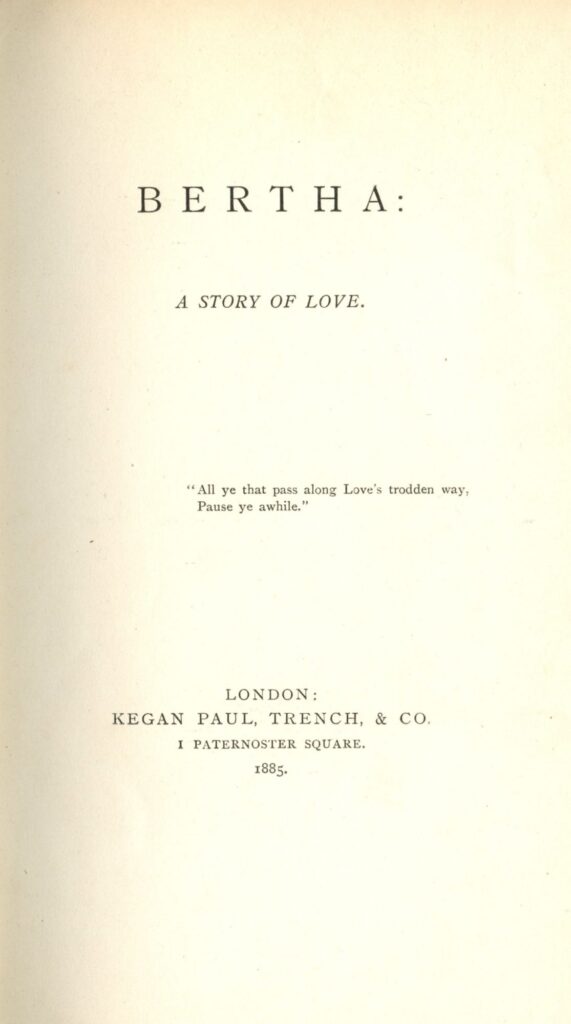
Twenty-one poems themed around love and estrangement.
Written by Charles E. Sayle as Anonymous.
Editions
- London: Kegan Paul, Trench, and Co (1885) first edition binding matches with Wiclif: An Historical Drama (1887)
Also see:
- “Charles Sayle (1864-1924): poet, bibliographer & librarian” (2014) by Liam Sims

Scan via Cambridge.
Read Now:
About:
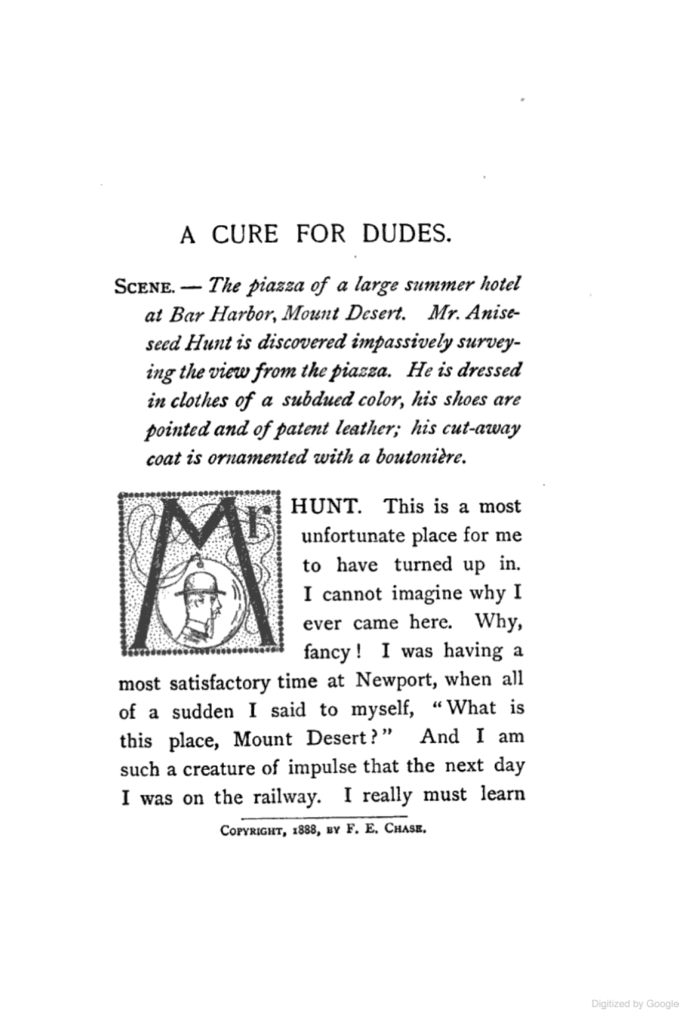
Mr. H., a bored dandy on vacation, resorts to a conversation with the only person he knows: Miss R, who mutually despises his company. They chat in a satire of Mr. H.’s peevish, effeminate nature until Miss R. scares him away with her “cure for dudes:” pretending to trap him in a marriage proposal to her.
Published in George Riddle’s Readings (1888) edited by George Riddle, pages 27-58.
Miss R. references Patience, the opera by Gilbert and Sullivan satirizing the Aesthetic movement, but through a character which does not exist in the opera: Algernon.
Mr. H references Du Maurier’s cartoons in Punch as his guide for the latest London fashions—those cartoons satirize the English Aesthetic movement.
I could not locate anything on a gentleman’s club popular for dandies named Knickerbein.
Editions
- F. E. Chase. Riddle’s anthology includes a copyright notice I could not locate.
- Boston : Walter H. Baker and Co.(1888) in George Riddle’s Readings, ed. George Riddle, pp27-58.
Read Now:
About:
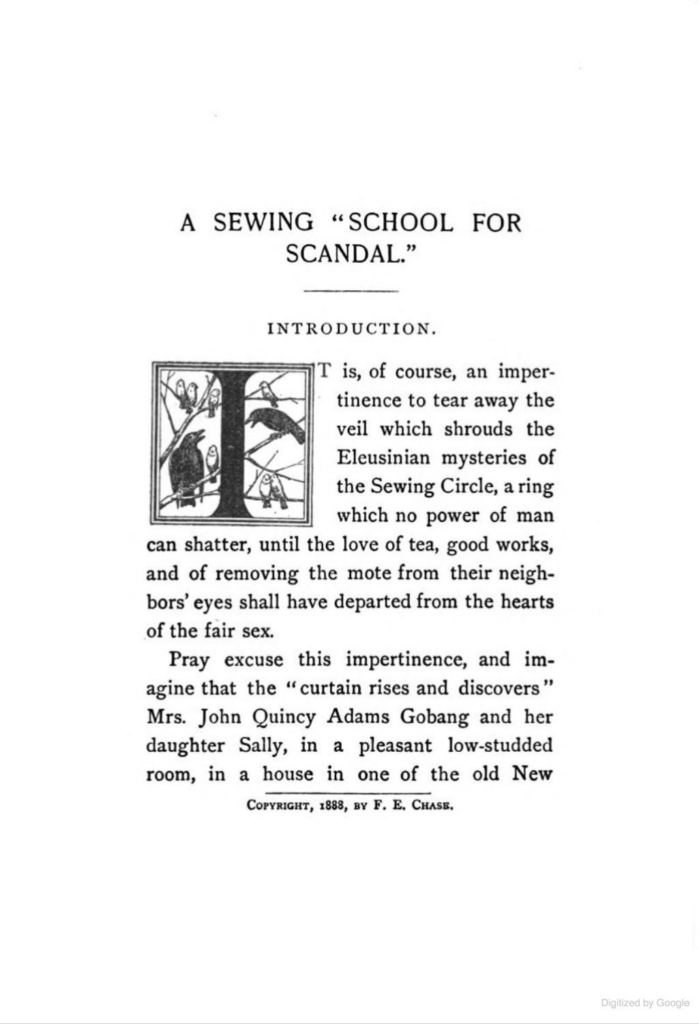
A group of women gather at a New England sewing circle for bad philanthropy and worse gossip. An artistic, feminine dandy attends, arousing the satirical amusement of the women, then is overshadowed by the entrance of a local clergyman.
Women dominate the conversation, interrupt and guide the men, and string the men along into direct insults or flirtations. In contrast, Mr. Limpkins and Mr. Lowkerk never resort to masculine anger or demands, remain subserviently polite, and are unperceptive or blushingly virginal towards their romantic teases. By entering a space that no man may enter, they are narratively positioned as something other than men—not quite one of the girls, but a class unable to fulfill a traditional relationship.
Published in George Riddle’s Readings (1888) edited by George Riddle, pages 61-95.
Editions
- F. E. Chase. Riddle’s anthology includes a copyright notice I could not locate.
- Boston : Walter H. Baker and Co.(1888) in George Riddle’s Readings, ed. George Riddle, pp61-95.
Read Now:
About:
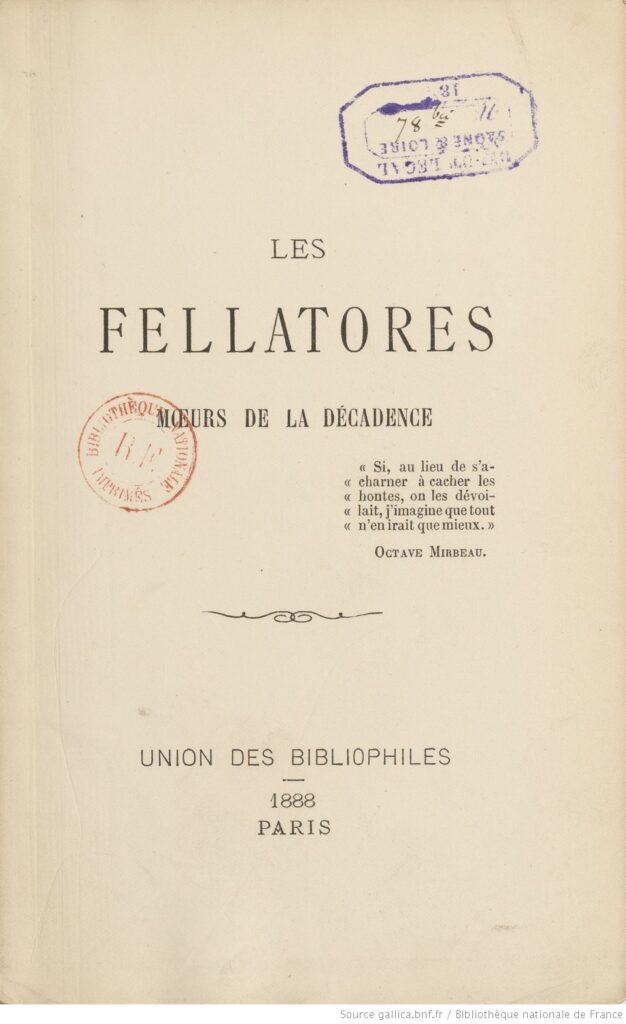
A decadent, erotic novel concerning a tangle of affairs and alaises. Period-typical gender fluidity plays a strong part which lends well to a transgender reading; it also contains several references to Rachilde’s genderqueer works, Monsieur Vénus and Madame Adonis.
Written by Paul Devaux as Dr. Luiz.
The book was successfully prosecuted for obscenity, and Devaux was sentenced to a year in jail with a 2,000-franc fine.
Also see:
- Figures of the Pre-Freudian Unconscious from Flaubert to Proust (2017) by Michael R. Finn. Cambridge University Press. (ISBN: 9781107184565). p215.
Editions:
- Paris : Union des Bibliophiles (1888) Cover seen at UBC.
- QuestionDeGenre / GKC (2011) reprint contains appendices, including the story “Côté des dames” by Devaux as Gygès. (ISBN: 9782908050714)
About:
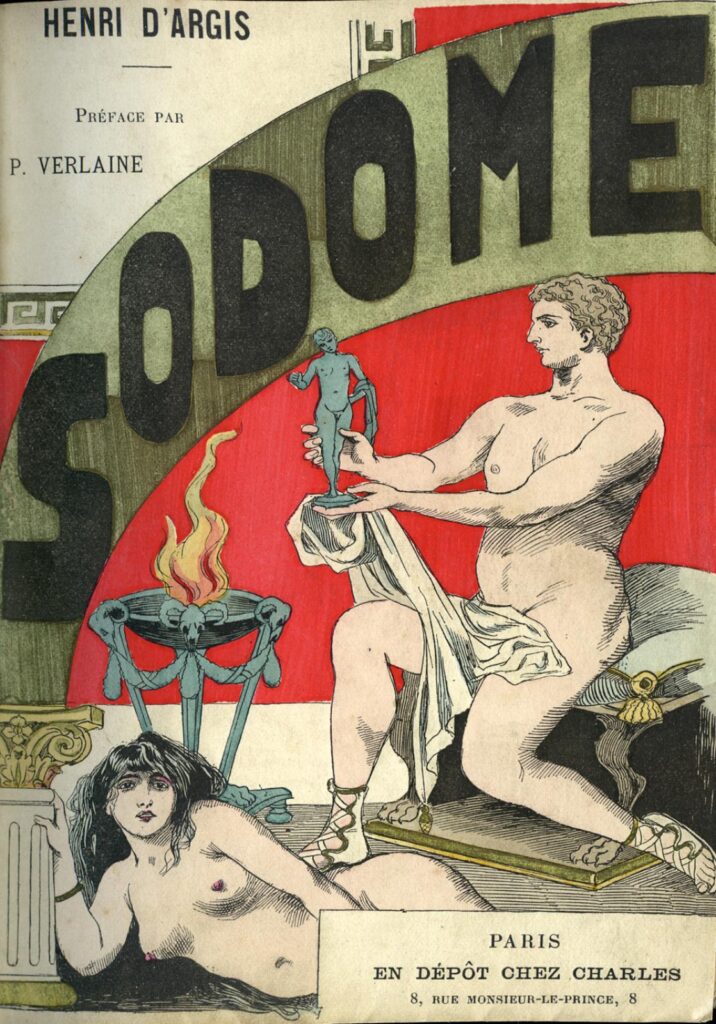
Jacques Soran, an young French nobleman, attempts to ignore his attraction to men by falling in love with woman. He rejects one of his lovers, an woman, when he learns that she is intersex and married to a docile wife. Finally, he discovers the 17-year old boy he loves with his mistress and goes insane.
Written by Alphonse Berty as Henri d’Argis. Contains a preface by Paul Verlaine.
The narrative believes victimhood is carried across hereditary lines. It is the companion text to Gomorrhe (1889).
Editions
- Paris : Alphose Piaget (1888) 30 copies. Seen at Bibliothèque Gay.
- Paris : Alphose Piaget (1889) Reissued with a pictoral cover to match its companion volume, Gomorrhe (1889), seen at Bibliothèque Gay.
Also see:
- Bibliothèque Gay (Mar 28, 2009 & Oct 10, 2020)
- “Proust and Ambient Medico-Literary Homosexualities 1885-1922” (2012) by Michael Finn.
About:
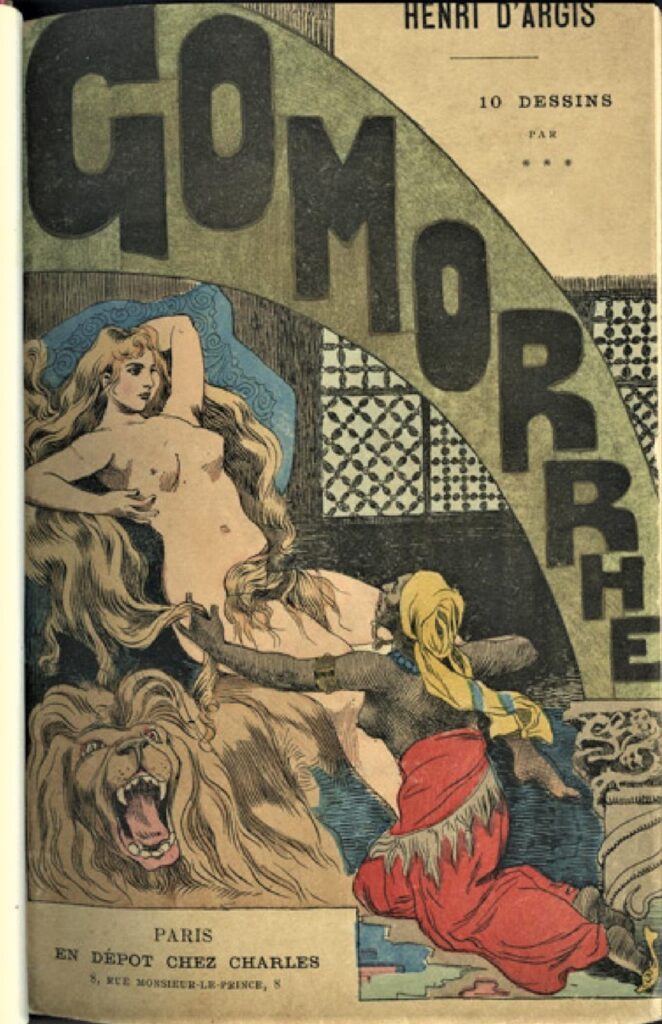
Madame Sonnet, a political spy, has a voracious sexual appetite. Despite the two women and the servant always accompanying her, she desires the sister of the man attempting to court her; she hypnotizes the sister and rapes her inert body. She then attempts to seduce the woman without trickery and fails.
Written by Alphonse Berty as Henri d’Argis. Contains a preface by Paul Verlaine.
The narrative believes victimhood is carried across hereditary lines. It is the companion text to Gomorrhe (1889).
Editions
- Paris : En Dépot Chez Charles (1888) cover by Bibliothèque Gay.
Read Now:
About:
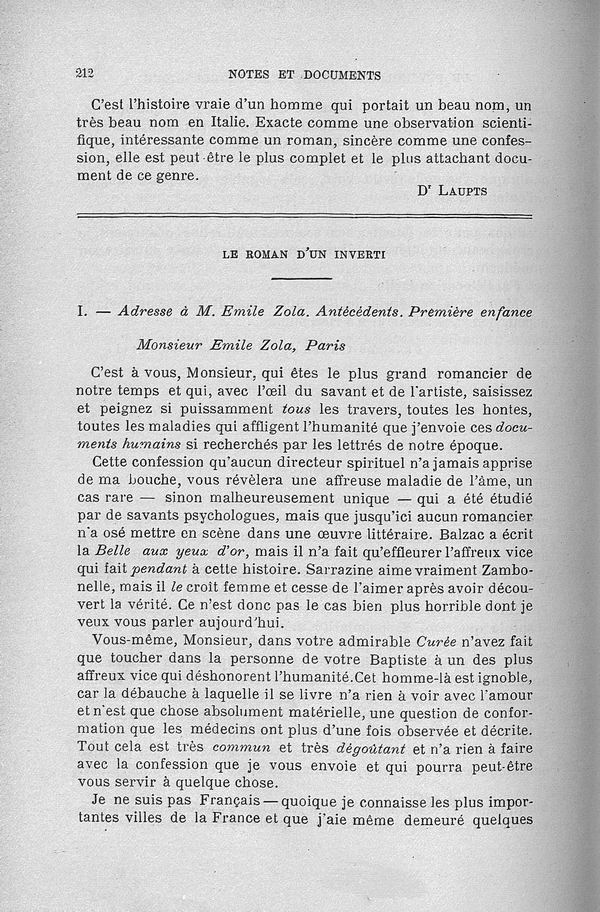
Novel of an Invert in English. After sending an epistolary summary of his life to Émile Zola to be made into a character, a gay man discovers that Zola had instead given his 1889 confessions to a sexologist to publish in 1896. Emboldened, the anonymous man then writes a joyous, flippant update to describe his loves and affirm his right to love other men.
Editions
- Paris: Archives d’Anthropologie Criminelle (1894), Vol 9, page 212.
- University of Nebraska Press (2008) in Queer Lives: Men’s Autobiographies from Nineteenth-Century France as “Novel of an Invert.” Translated by William A. Peniston and Nancy Erber. (ISBN: 978-0803260368)
- Paris : Les Nouvelles Éditions Jean-Michel Place (2017) as Confessions d’un homosexuel à Émile Zola. Première édition non censurée du « roman d’un inverti ». Edited by Michael D. Rosenfeld. Unexpurgated. (ISBN: 9782376280033)
- Columbia University Press (2022) as The Italian Invert: A Gay Man’s Intimate Confessions to Émile Zola. Edited by Michael D. Rosenfeld and William A. Peniston, translated by Nancy Erber. Unexpurgated. (ISBN: 978-0231204897)
About:
An autobiographical novel of an astute French soldier, constantly in and out of military prison, and sent to Tunisia. Primarily a depiction of inhumane treatment and suffering, although there is a segment about the allure of homosexuality.
Also see:
- Uranisme et unisexualité : étude sur différentes manifestations de l’instinct sexuel (1896) Marc André Raffalovich (114-116pp).
- Marc-André Raffalovich’s Uranism and Unisexuality (2016) translated by Nancy Erber and William A Peniston, edited by Philip Healy and Frederisk S. Roden (115-117pp).
Read Now:
About:
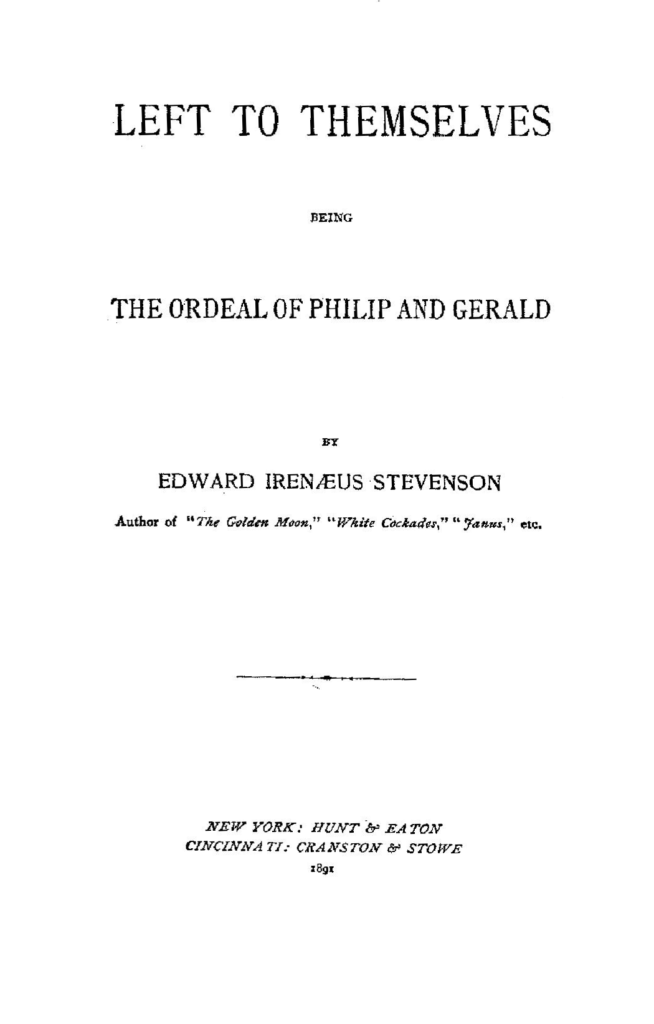
After the 12 year-old Gerald is rescued from a robber by the 17 year-old Philip, the two embark on a journey to return Gerald to his stockbroker father in Halifax. They contend with a revenge-bent kidnapper, a ship wreck, illness, and the shadow of Philip’s disreputable father.
Also see:
- “Left to Themselves: The Subversive Boys Books of Edward Prime-Stevenson (1858-1942)” by James Gifford
- “Between Boys: Edward Stevenson’s Left to Themselves (1891) and the Birth of Gay Children’s Literature” by Eric L. Tribunella in Children’s Literature Association Quarterly (2012) Volume 37, Number 4, Winter, 364-388pp.
Editions:
- New York : Hunt and Eaton (1891) Published simultaneously with the latter:
- Cincinnati: Cranston and Stowe (1891)
About:
Literally, “Fate.”
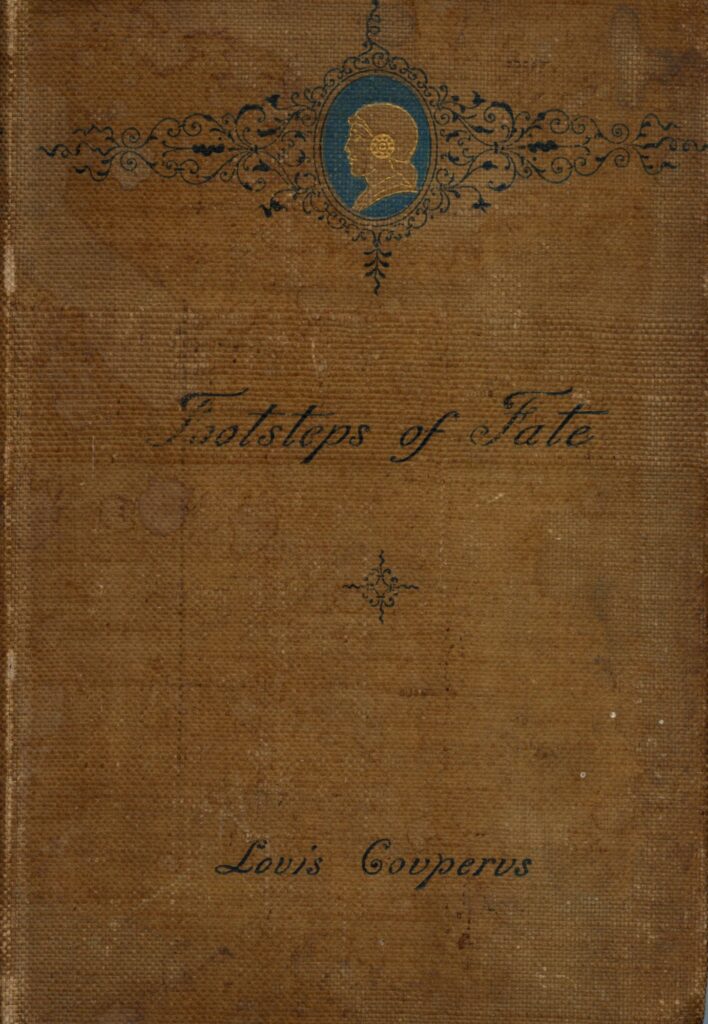
A novel of estrangement and jealousy in marriage. Bertie, the friend, and Eve, the wife of Frank, are in turn envious of each other over Frank’s affections. Bertie hides Eve’s letters, causing the Frank to believe she no longer loves him; when Frank discovers this, he kills Bertie and is imprisoned. After his release, the married couple commit suicide.
Gerrit Jäger produced a play version of the novel, which was performed in 1892 by the Rotterdam theatre company; Willem Royaards, an acquaintance of Couperus, played one of the main roles.
Editions
- De Gids (1890) first publication.
- Amsterdam: L. J. Veen (1891) first book edition.
- London : Heinemann (1891) 272pp. English tr. Clara Bell as Footsteps of Fate.
- New York : Appleton (1892) 272pp. English tr. Clara Bell as Footsteps of Fate with introduction by Edmund Gosse. Cover and title page seen at Elysium Press.
- Stuttgart : Deutsche Verlags-Anstalt (1892) German tr. Paul Raché as Schicksal.
- Stockholm : C. and E. Gernardts (1899) Swedish tr. Gustaf Uddgren as Under Vänskapens ok.
- Budapest : Singer és Wolfner (1899) Hungarian tr. Paul Raché as Végzet.
Read Now:
About:
A schoolboy novel based on the author’s experience at Eton College. Originally published anonymously.
About:
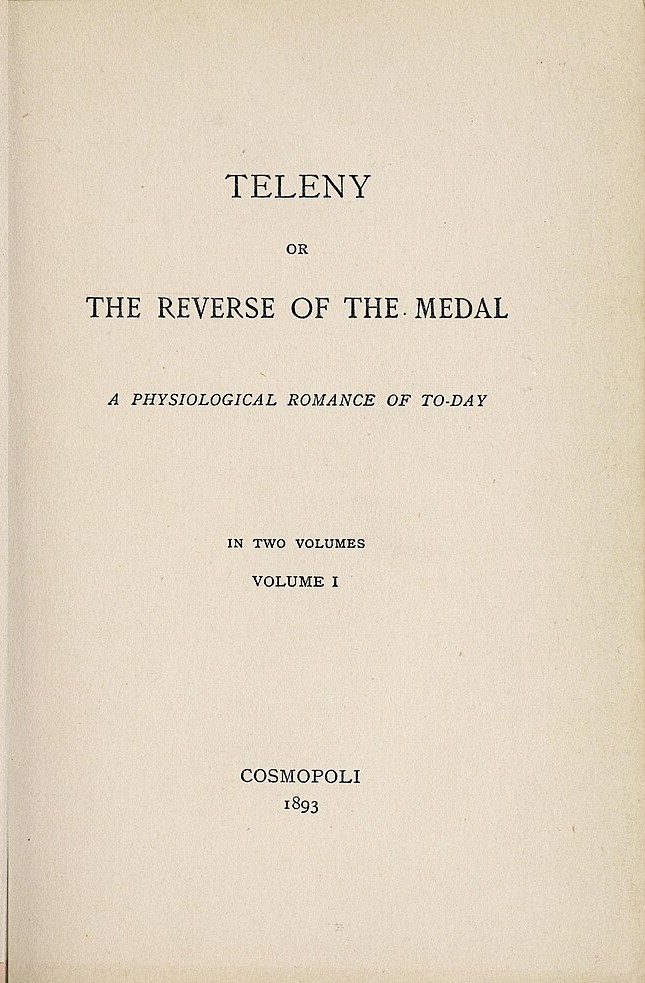
A pornographic novel said to have been written by several authors including Oscar Wilde. The pianist Teleny and the protagonist des Grieux fall in love, distract each other from that love with sex with others, and eventually face themselves.
Occasionally subtitled or named, The Reverse of the Medal and A Physiological Romance of To-day. Published by Leonard Smithers as Cosmopoli in 200 copies of two volumes. Seven known copies are left. The first volume has 163 pages, and the second has 191.
Des Grieux: The Prelude to “Teleny” was published in 1899 Leonard Smithers, London.
In the 1934 reprint, Charles Hirsch explains that the original publishers, Smithers, gave the original transcript to a friend who passed it to him (Dominique Leroy). Here, he explains that the document seemed to have been written in several hands—including Wilde’s. This translation also shifts the setting of the novel from Paris to London, and contains several small changes to the text (Fraser Riddell). Further changes to the differing texts are outlined in “The Introduction to the 1986 GMP edition of Teleny” by John McRae.
Also see:
- “Queer Music in the Queen’s Hall: Teleny and Decadent Musical Geographies at the Fin de Siecle” (2020) by Fraser Riddell
- THE OSCOLAR’S Special Teleny Issue
Additional Editions
- Paris : Charles Hirch (1934) as Teleny: étude physiologique. Includes a “Notice Bibliographique” written by Hirsch.
Content & Trigger Warnings
Chapter V:
- RAPE: of a female character by the protagonist.
- SUICIDE: of the raped female character.
Chapter VI:
- SUICIDE: attempted by the protagonist.
Chapter VIII:
- SUICIDE: of a minor character.
- SUICIDE: of a main character
Read Now:
About:
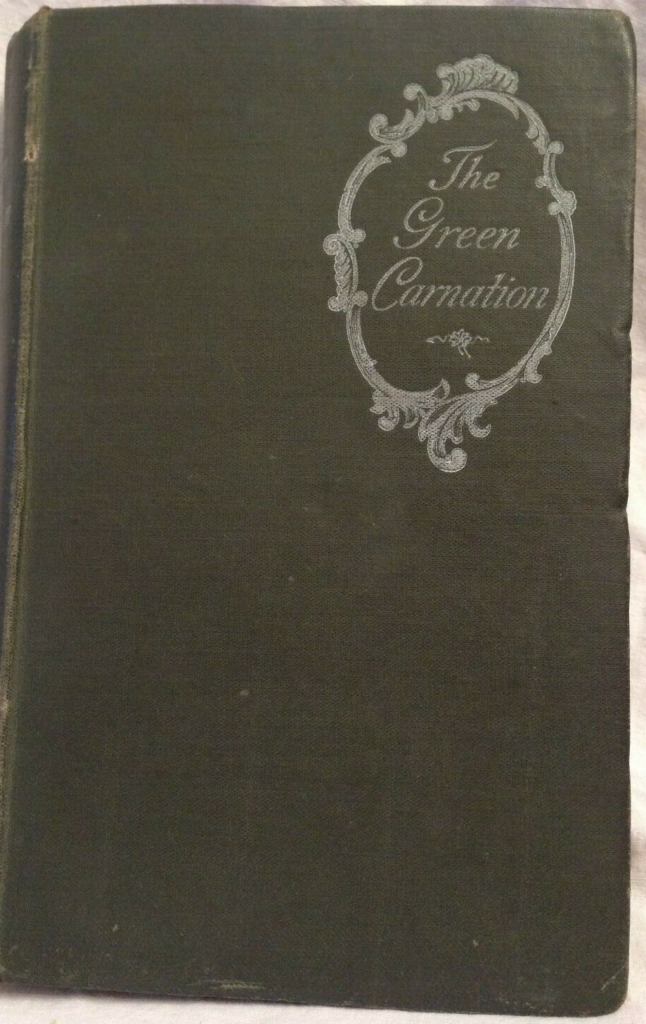
A satire of Oscar Wilde and Bosie written by a friend and containing dialogue from real conversations with them. A woman finds herself entranced by the effeminacy of the Bosie figure, who entertains marrying her before he comes to his senses.
The book was used against Wilde in his infamous court trails, causing the publisher and Hichens to withdraw the book from sale in England. It continued to be produced in the US.
It was originally published anonymously. Wilde wrote to the Pall Mall Gazette on October 2, 1894 to declare that he had not written the novel.
The book is filled with references to artistic contemporaries and 1890’s pop culture, so it can be a little difficult to follow every joke. The University of Nebraska Press (1970) version, edited by Stanley Weintraub, contains a helpful glossary.
Editions
- London : William Heinemann (1894) first English edition. The title page states “Pioneer Series” at the top and features an image of four Japanese women. Seems to be in print through 1901, when Hichen’s name is added.
- New York : D. Appleton and Company (1894) first American edition is available at Archive.org. Seems to be in print through 1899. The 1895 edition is available at Google.
- Chicago : Argus Books (1929)
- London : Unicorn Press (1949) edition is the first to be published in England after Hichens ended publication during the Wilde Trials. It includes a foreword by Hichens on his relationship to Wilde, Bosie, E. F. Benson, and the book. Richard Dalby’s Library hosts pictures of the book and dust cover from all angles.
- Icon F2, British (1961) paperback edition.
- University Press of Nebaska Press (1970) edition with an introduction by Stanley Weintraub is available on Archive.org. Contains a glossary for pop culture references.
Trigger Warnings
Read Now:
About:
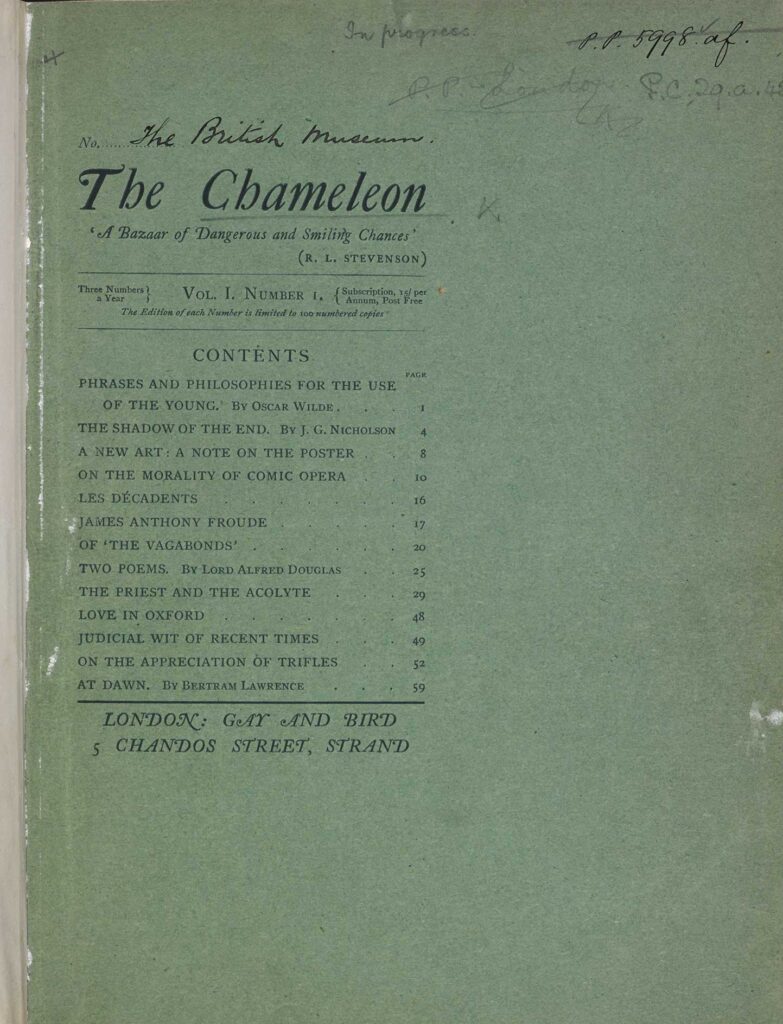
Subtitled A Bazaar of Dangerous and Smiling Chances. A collection of thirteen pieces of different formats and authors—nearly all of them queer. It was intended to be a three-part serial but the first issue’s objectional content folded the initiative.
“Phrases and Philosophies for the Use of the Young” – Oscar Wilde
A series of quotations and epigrams, some rephrased from previous work.
“The Shadow of the End” – John Gambril Nicholson
A mix of prose and poetry concerning the narrator’s relationship with a male love’s death. The word “Prince” is commonly used by Nicholson to denote his love, as in his poem “Of Boys’ Names.”
“A New Art: A Note on the Poster”
A short review of an art exhibit focusing on posters at the Westminster Aquarium. Lauds Cheret and Toulouse-Lautrec among others.
“On the Morality of Comic Opera”
A flippant criticism and satire meant to prove that Comic Opera has as much moral and morbid content as other operas, yet Purist critics hypocritically only attack the latter.
“Les Décadents”
A joyous poem calling for toasts of wine to a list of queer figures in history, including Antinous and Sappho.
“James Anthony Froude” – A.
An obituary for Froude, a history writer and Oxford professor. It defends any inaccuracies in his histories for what he makes up in sympathy and style. Outside of this lauding piece, it seems Froude’s work was profoundly imperialist and anti-Catholic—and popular despite its controversy.
“Of ‘The Vagabonds,’ by Margaret L. Woods” – G.
A review which begins by explaining that women writers have little imagination yet make up for in observation. The author proceeds to explain that Wood’s literature is extraordinary for her limitless perception, particularly in her new circus-focused book, The Vagabonds.
“Two Poems: ‘In Praise of Shame’ and ‘Two Loves'” – Lord Alfred Douglas
Poems with direct context for homosexual love. “Two Loves,” the origin of the line “the love that dare not speak its name,” is famous for its use in the Wilde trials.
“The Priest and the Acolyte” – John Francis Bloxam as X.
A short story about a 28 year-old priest and his love, a 14 year-old acolyte, which concludes with a direct defense of homosexuality. Occasionally misattributed to Oscar Wilde and even included in some early versions of his collected work.
“Love in Oxford”
A simple poem of a narrator yearning for their male love to return to them.
“Judicial Wit of Recent Times” – K.
A report or satire on the inefficacy of court judges in several ridiculous anecdotes.
“On the Appreciation of Trifles” – Lionel Johnson as L. (source)
An essay concluding that there is no secret to life and that life is meant to be enjoyed for what it offers. It makes its argument on small indulgences forgone to save money and conscience, but also from a purely aesthetic view that too many ugly things are tolerated when they can be beautified.
“At Dawn” – John Francis Bloxam as Bertram Lawrence
A poem describing the narrator’s love, revealed at the end to be a “boy-king.”
Editions
- London : Gay and Bird (1894) in 100 copies. Cover, Wilde’s and Bosie’s contributions by the British Library.
- London : Eighteen Nineties Society (1978) Facsimile printed in 750 copies. 68pp. Adds an introduction by H. Montgomery Hyde and “On the Chameleon: An Essay” by Timothy d’Arch Smith.
Content & Trigger Warnings
Read Now:
About:
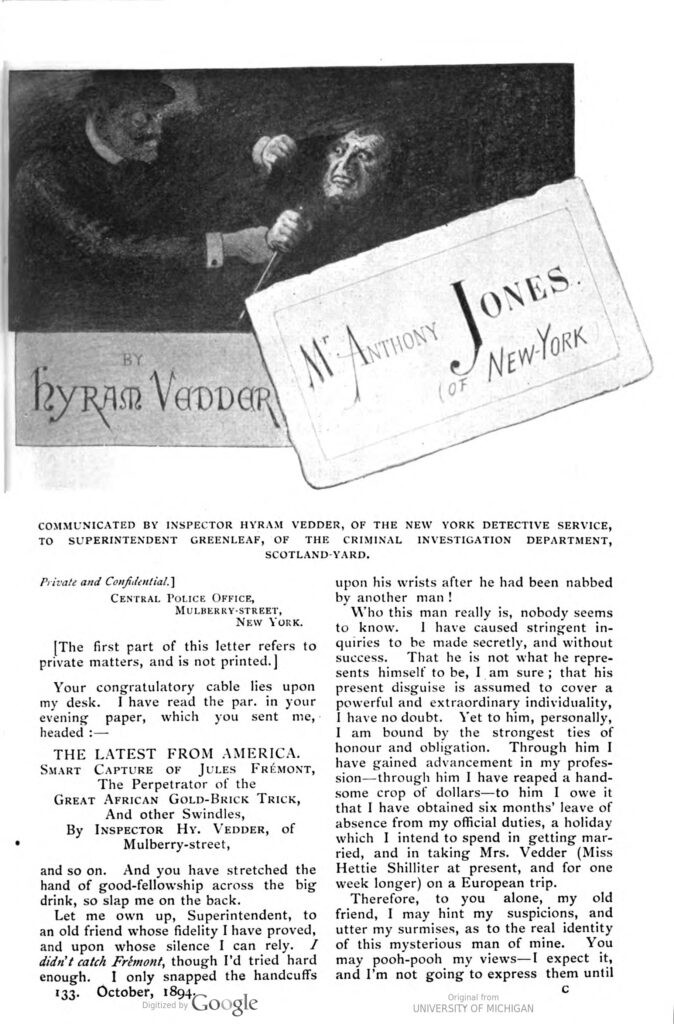
A New York detective is approached by Anthony Jones, dandy with a peculiar request. Given 24 hours, half the reward money, and a promise for anonymity, Jones would find and arrest the Frenchman wanted for defrauding the government with false bricks of African gold. A Sherlock Holmes pastiche.
Illustrated by Amédée Forestier. Published in English Illustrated Magazine, Vol 12. Oct 1894. p17-28.
The sequel story is “Mr. Swagg of London,” published in English Illustrated Magazine, Vol 13. Aug 1895. p451-458.
Read Now:
About:
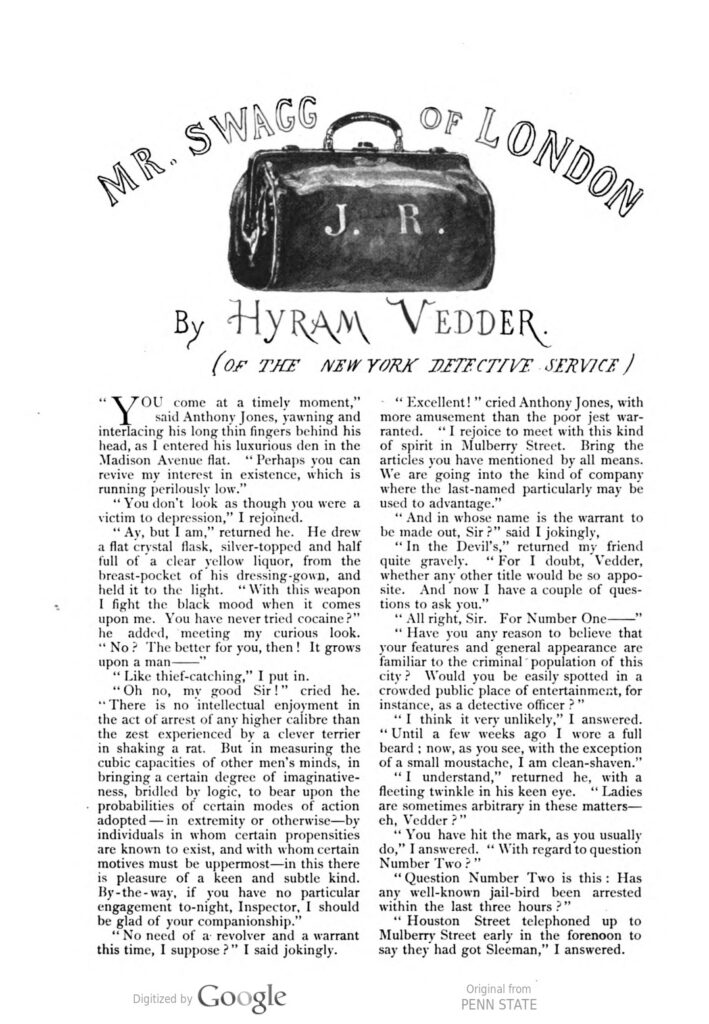
Vedder and Jones collaborate to attend a giant meeting of thieves and criminals to apprehend the gathering’s guest of honor: a British burglar and murderer set on revenge.
The sequel to “Mr. Anthony Jones of New York” and a Sherlock Holmes pastiche.
Published in English Illustrated Magazine, Vol 13. Aug 1895. p451-458.
About:
A gay count and his love for a peasant, and the attack by his community set on him by a woman jealous for the count’s affections.
The novel motivated authorities to place Eekhound on trial in October 1900 for depicting homosexuality, but he was eventually acquitted.
Also see:
- “Gay Taboos in 1900 Brussels: The Literary, Journalistic and Private Debate Surrounding Georges Eekhoud’s Novel Escal-Vigor” (2018) by Michael Rosenfield
- “Du national au transnational. Escal-Vigor (1899) et sa traduction en néerlandais” (2014) by Kris Peeters
- “Martyrologe d’un genre nouveau: Le Dénouement d’Escal-Vigor de Georges Eekhoud” (2006) by Philippe Chavasse
Editions
- Paris : Société du Mercure de France (1899) 261p.
- Paris : Mercure de France (1901) 252p. Spine seen at La Bataille des Livres. Title page by Wikimedia.
- Bruxelles : The Gutemburg Press (1909) in English. 271p. 1,150 copies.
- New York : Panurge Press (1930) as A Strange Love: A Novel of Abnormal Passion. 252p. 1,010 copies, 10 for the press editors

Trigger Warnings

Read Now:
About:
The seduction of Camille Des Greiux’s grandmother in her youth, as well as the sexual development of her unnamed son and Camille’s father.
A pornographic novel related to Teleny (1893) as a sexual history of Des Greiux’s family. The first two chapters are of Camille Des Greiux’s grandparents, Camille Des Grieux (grandmother) and Gaston Des Grieux (grandfather). The third and final chapter is from the view of their unnamed son, Camille’s (Teleny) father (Peter Mendes).
Said to have been written by the same group of anonymous authors including Oscar Wilde. Publication details are unstated. There are three known copies left. Justin O’Hearn, a student at the University of British Columbia, launched a Kickstarter to purchase one of them along with a copy of Teleny to make them freely available online (UBC).
Also see:
- Teleny and Des Grieux Media roundup by UBC
- Clandestine Erotic Fiction in English 1800—1930: A Bibliographical Study (1993) by Peter Mendes. 310-311pp.
Trigger Warnings
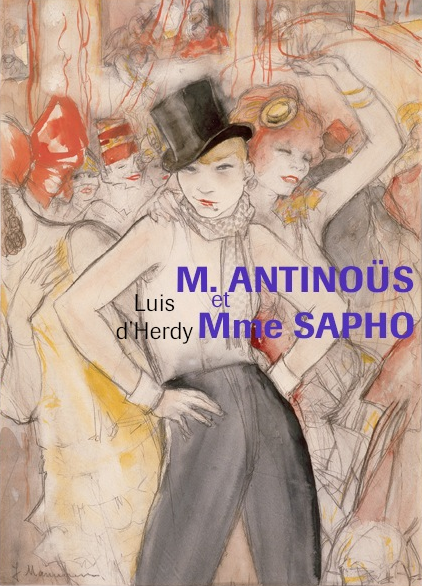
About:
A gay man and a lesbian marry for convenience, both cross-dressing, then part to find love elsewhere before they finally realize they are already a match for each other.
May either be inspired by or a a pastiche of Rachilde’s Monsier Venus.
Also see:
- Brief description in Nordic Literature of Decadence (2019) by Mirjam Hinrikus, Pirjo Lyytikäinen, Riikka Rossi, Viola Parente-Čapková. Taylor & Francis.
Editions
- Paris: Girard and Villerelle (1899)
- GayKitschCamp (2013) reprint. 100p. (ISBN 978-2908050820). The cover is “She Represents” (c1928) by Jeanne Mammen.
Read Now:
About:
A melodramatic novel from the POV of a woman who discovers her husband’s affair with an older male army captain.
Also see:
- “‘Oh God, There is No Woman In This’: A Marriage Below Zero, the Somerset and Russell Scandals, and the Sodomitical Threat to Victorian Marriage” (2013) by Richard A. Kaye
- “The Return of Damon and Pythias: Alan Dale’s A Marriage below Zero” (2002) by Richard A. Kaye
Editions
- New York: G.W. Dillingham (1899) First Edition.
- Broadview Press (2017) ed. by Richard A. Kaye to include excerpts of comparable cases in history to the novel, including court cases by wives who discover their husbands’ homosexual infidelity.
Trigger Warnings
Read Now:
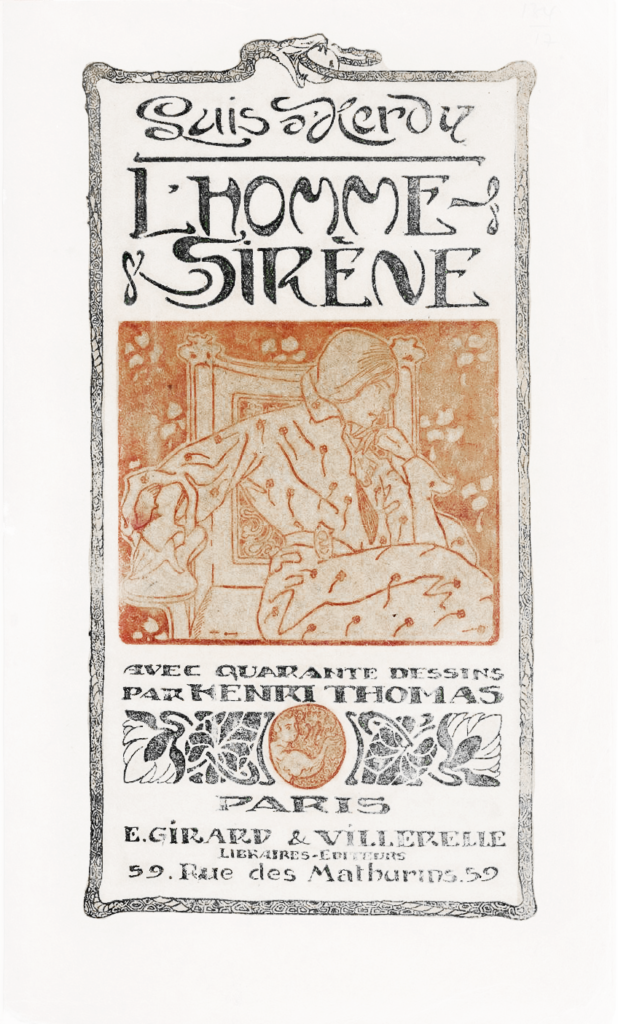
About:
According to Elysium Press, it features drugs and bohemia. Over three publications reference it for the use of perfume: like René Teleny, Édouard d’Ore wears white heliotrope. Contains 40 illustrations by Henri Thomas.
Cover restored by myself. Another picture of it may be seen at the University of British Columbia’s Queer Collections Project.
Editions
- Paris: Girard and Villerelle (1899) second edition by the Bibliothèque Nationale de France on Gallica.

Read Now:
About:
Seems to be about a school boy who abandons his love for a girl to pursue another girl, Nita, “as much boy as girl” until he turns to love a boy named Elsie.
About:
Fifteen year-old Claudine’s life at her Motigny school, her observation of others’ romances, and her romance with the headmistress’ assistant, Aimée Lanthenay.
The first book of the Claudine series. Followed by Claudine à Paris (1901).
Editions
- Paris : Société d’Éditions Littéraires & Artistiques (1900) First edition.
- London : Secker and Warburg (1900) as Claudine at School. 286pp. Tr. Antonia White.
About:
Fictionalizes de Pougy’s affair with Natalie Clifford Barney. Sick of her life as a famous courtesan, Annhine de Lys falls in love with the boisterous passion of the American woman Flossie.
Contains a portrait by Antonio de la Ganadara, seen at Elysium Press.
A few scans of the original manuscript can be seen at Invaluable.
Editions
- Paris: Librarie de la Plume (1901) seen at Artcurial, embellished with signatures, drawings, letters, photographs, and so on. The title page is at the blog Mister Giueseppe.
- Barcelona: Madrid Egales (2009) as Idilio Sáfico. Translated to Spanish by Luis Antonio de Villena. (IBSN 978-8488052971)
- Dedalus (2021) as A Woman’s Affair. Translated to English by Graham Anderson. Cover by Marie Lane. (ISBN 978-1912868483)
About:
The autobiography of Claude Hartland, detailing his experience with sexual identity, experiences with doctors, guilt and religion, and the queer community in St. Louis.
Subtitled, “For the Consideration of the Medical Fraternity.“
About:
Claudine, now 17, moves to Paris and embraces sensuality, braced by the encouragement of her sex-driven maid and by her dominance of a former lover, the girl Luce. She attempts to seduce her gay male cousin before falling in love with the boy’s father, Renaud.
The second book of the Claudine series. Preceded by Claudine à l’école (1900) and followed by Claudine en ménage (1902).
Editions
- Paris : Paul Ollendorff (1901) First Edition.
- London : Secker and Warburg (1901) as Claudine in Paris. Tr. Antonia White. 204pp.
Read Now:
About:
Claudine and Renaud marry and return from their honeymoon as a couple distanced by contrasting age and values. Within the knowledge and permission of her husband, Claudine begins an affair with the woman Rézi, a character based on Georgie Raoul-Duval, a real-life lover of Colette and Willy.
The third book of the Claudine series. Preceded by Claudine à Paris (1901) and followed by Claudine s’en va (1903).
Editions
- London : Secker and Warburg (1902) as Claudine Married. Tr. Antonia White.
Trigger Warnings
Read Now:
About:
The narration shifts to Annie, a woman bound in a crumbling marriage to a cruel childhood love. Through her sister-in-law’s social circle, she becomes romantic friends with Claudine and Suzy, another character inspired by Georgie Raoul-Duval.
The fourth book of the Claudine series. Preceded by Claudine en ménage (1902) and followed by La Retraite Sentimentale (1907).
Editions
- Paris : Paul Ollendorff (1903) First Edition.
- London : Secker and Warburg (1962?) as Claudine and Annie. Tr. Antonia White
- New York : Farrar & Rinehard (1930) as The Innocent Wife. Tr. Frederick A. Blossom. Illus. J. O’H. Cosgrave, II.
Read Now:
About:
A novel by and about an aspiring writer from San Fransisco. Each relationship is given presence, and one of those is Miss Juno, prefers to be called “Jack.”
Fully titled For the Pleasure of His Company: An Affair of the Misty City, Thrice Told.
The book’s protagonist is ridiculed as “A Raving Egotist” in the New York Times (June 20, 1903).
Editions
- San Francisco: A. M. Robertson (1903) cover from Skinners. Designs by Marshall Douglass.
Read Now:
About:
Forty-four poems dedicated to John Marshall, Warren’s lifelong partner.
Highlights: “Before the Iron Doors,” “New and Old,” “Love on the Way.”
Trigger Warnings
Author Details:
Read Now:
About:
Pipelines in English. More information on De Haan and his work at the GL Review.
De Haan wrote a sequel to the book but the manuscript was never published and is assumed lost or destroyed.
The main characters’ original names, Joop and Sam, referred to de Haan and to Arnold Aletrino, to whom De Haan dedicated the book. Aletrino disliked this and attempted to buy out copies of the book to remove it from circulation.
Editions
- Amsterdam : Jacq Van Cleef (1904) cover by Fokas Holthuis on Abebooks.
- Amsterdam : Jacq Van Cleef (1904) The second edition is subtitled het leven van Cor Koning en Felix Deelman/The Life of Cor King and Felix Deelman. It adds another 10 pages and changes several parts of the text: additional paragraphs were added, the names of the main characters were changed, and the character described as “fourteen years old” was changed to “not yet an adult.”
Read Now:
About:
A novel themed on motherhood interspersed with the diary entries of its protagonist, Kamilla Kramm. Her first love, a young girl she was the governess of, grows up to marry a man. Kamilla then becomes governess to a different young girl, who she has a brief confusion of maternal and romantic feelings. She also hosts a burning love for the girl’s father, Leopold von Buchwald, and a jealous attraction towards von Buchwald’s female mistress. Finally, after marrying a man she did not love, she enters a sadomasochistic relationship with her husband’s male friend, Karl Wolf.
Diary of a Kindergarten Teacher in English.
Trigger Warnings
Read Now:
About:
Black Masses: Lord Lyllian in English.
Cover illustration by Claude Simpson. The quote by Wilde on the cover seems to be invented.
Editions
- Leon Vanier (1905) cover by Wikimedia.
- Elysium Press (2005) English edition limited to 500 copies.

Read Now:
About:
A schoolboy novel of Harrow School where two boys complete for the love of another. Features the Second Boer War. Its sequel is Josh Verney (1911). The book remained in print by John Murray press for over 45 years.
Dedicated to George W. E. Russell, to whom Vachell relates to the main characters of the book: “there are such boys as Verney and Scaife, nobody knows better than yourself.” Russell describes his own time at Harrow in a chapter of his autobiography.
Wilfred Owen also read the book and described it in the February 21, 1918 letter to his mother, Susan Owen: “Am now reading a book by Vachell The Hill, a tale of Harrow, and the hills on which I never lay, nor shall lie: heights of thought, heights of friendship, heights of riches, heights of jinks. Lovely and melancholy reading it is for me.”
Read Now:
About:
A collection of the sexual adventures of four young boarding school boys, including
Although the author claims that the book is a memoir, Charlie Powerscourt did not exist.
Also see:
Editions
- Paris : Charles Carrington (1905) 150 copies of three volumes. Claimed to have been printed in New Orleans. Later republished in two volumes by the same publisher, this time falsely labeled as “James Kennedy, 40, Fenchurch Street, London.”
Content & Trigger Warnings
UNDERAGE SEX:
- The entire novel.
RAPE and SEXUAL ASSAULT
- Chapter 1: A 16 year-old boy, who learned from his cousin in his 20s, introduces a 13 year-old boy to sex (oral, hand jobs, anal).
- Chapter 2: The pair from the first chapter rape another boy around the age of 13 (hand job, oral), who then reciprocates (hand job, anal fingering) and brags about having sex with another boy of his age.
- Chapter 5: Two 15 year-old brothers expose a younger boy, then spit on his privates and coat them with grease.
- Chapter 6: Cecile hires a new maid, and orders the prepubescent girl to strip. The boy fingers the young girl and the woman gives her oral. The woman forces the girl to give the boy a hand job, and then to suck his cock. She takes the girl’s virginity with a dildo, then spanks her with a birch stick until she comes. The protagonist then touches and sucks a sleeping boy’s cock.
- Chapter 8: One of the 15 year-old brothers breaks into one of the boy’s shower and grabs his cock, demanded that they frig each other.
- Chapter 9: Several older teenagers sexually harass a teen boy by pulling his pants down, handling his cock, and sticking mud, hay, and other materials to him. Another boy and an adult maker also force hand jobs upon the teen after pressing to the floor or tying him up.
- Chapter 10: One of the boys tries touching Cecile, but she wakes and tells him to continue (vaginal fingering). She handles and sucks his cock, and has vaginal sex with him while another boy provides her with anal sex.
- Chapter 11: The women and boys go to a sex party, where naked women touch and pour cum over a young boy, then 16 year-old boys gang rape a 14 year-old girl. The women and boys continue to have sex.
PEDOPHILIA:
- Chapter 4: A twenty-two year-old woman named Cecile and her maid rape a 12-13 year-old boy after having him drink several glasses on wine. (vaginal fingering & oral, anal fingering, blow job, penis in vaginal sex). He then reciprocates to the maid (vaginal fingering & oral).
- Chapter 5: Cecile takes the boy to a lesbian orgy. Afterwards, a man ties to rape him; upon discovering that he is a boy, he forces the boy to provide oral sex, then anal sex. The woman gives the boy oral in apology.
- Chapter 6: Cecile and the same boy continue to have sex (hand job, object insertion, oral). She spanks a different 12 year-old boy with the stick, then douses his cock in cold water.
- Chapter 7: A woman ties a 13 year-old boy into a hanging harness by his wrists and spanks him with a rod. She then spanks the protagonist despite his refusals, although he changes his mind. Cecile has sex with the protagonist (oral).
- Chapter 8: One of the school masters has a sexual relationship with one of the boys (hand job).
- Chapter 9: After a 15 year-old propositions her, a widow has sex with him.
- Chapter 12: The protagonist visits the cousin of the 16 year-old in Chapter 1. The elder man has the boy strip, read erotica, and have sex (oral, intercrural, anal fingering).
- Chapter 13: The cousin employs two 13 year-old Japanese boys as servants. He’s also employed a “rather younger” orphan “quite a long time.” The boys bathe the protagonist, then lick syrup from his naked body alongside the cousin. The protagonist is also instructed to lick sweets from the orphan’s body twice. The cousin, Black men, Japanese boys, orphan, and protagonist continue to have sex. The rest of the boys from school eventually join in.
BESTIALITY:
- Chapter 4: A calf sucks on the cock of a man tied to a tree in punishment for stealing fruit.
- Chapter 7: A woman has her pet dog lick her cunt.
- Chapter 11: A “strong mulatto youth, with an enormous genital organ” and a black woman with “massive posteriors” have sex with goats. Two women allow dogs to lick their cunts.
RACISM:
- Chapter 11: An Arabic boy and girl who “come to maturity, genitally speaking, at a far earlier age” have sex on stage.
- Chapter 12: An English man employs two Black servants, who he calls Peter and Paul because “their native names are too cumbersome.” The man’s house is full of oriental furnishings.
- Chapter 13: After the two Black servants are made to perform “feats of strength and agility,” they are given hand jobs by the orphan.
Read Now:
About:
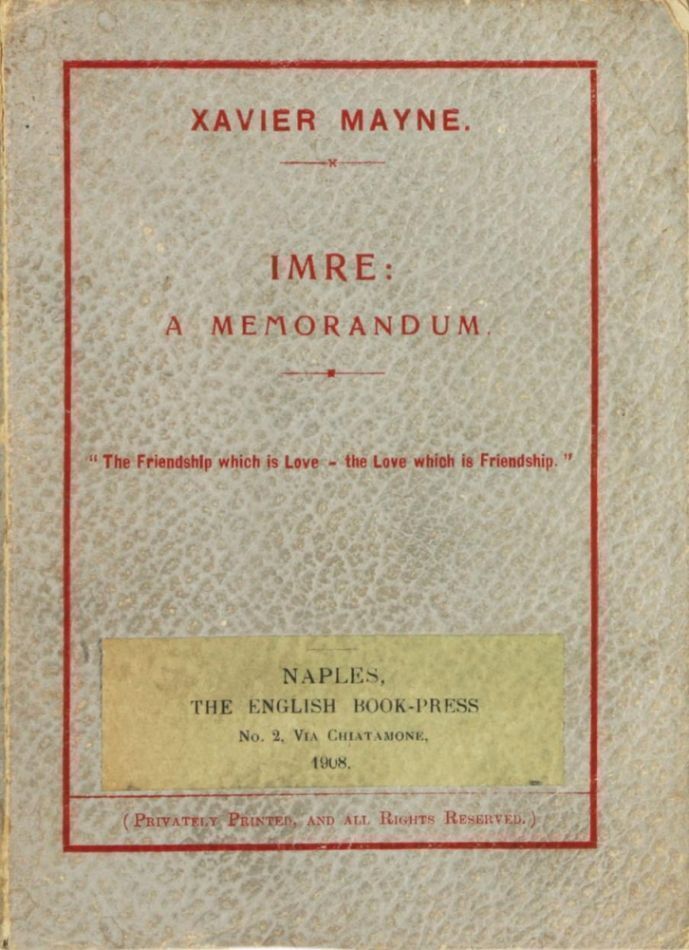
A queer experience novel of love and vulnerability as a character study of isolated Hungarian solider Imre von N. by his lover, Oswald, a displaced English noble.
Published under the pseudonym Xavier Mayne. Epigraph likely adapted from Marc-Andre Raffalovich’s poem “The World Well Lost”—a phrase also used in Imre: A Memorandum.
Two of Prime-Stevenson’s short stories give reference to Imre and Oswald respectively:
-
- “‘Madonnesca'” in Her Enemy, Some Friends, and Other Personages (1913)
- “Prince Bedr’s Quest” in Long-Haired Iopas (1927).
Also see:
- Dayneford’s Library – American Homosexual Writing 1900-1913 (1995) by James Gifford.
“Sexology, Homosexual history, and Walt Whitman – the ‘Uranian’ identity in Imre” (2010) James Patrick Wilper. - Reconsidering the Emergence of the Gay Novel in English and German (2016) by James Patrick Wilper.
- “Ghosts in the Archives: the Queer Knowledge and Public Musicology of Vernon Lee, Rosa Newmarch, and Edward Prime-Stevenson” (2018) by Kristin Franseen
- “Slum or Arcadia? Hungary as ‘other space’ in Imre by Edward Prime-Stevenson” (2019) by Zsolt Bojti
- “Narrating eros and agape: Erotext in the exposition Edward Prime-Stevenson’s Imre: A Memorandum” (2020) by Zsolt Bojti
- “ANONYMOUS and Badboy Books: A 1990s moment in the history of pornography” (2020) by Barry Reay and Nina Attwood
- “Queer Music in the Queen’s Hall: Teleny and Decadent Musical Geographies at the Fin de Siecle” (2020) by Fraser Rissel
- “Homosexual Identity Translation and Prime-Stevensons Imre and the Intersexes” (2021) by Margaret S. Breen
Editions
- Naples : The English Book Press (1906) first edition cover is from Elysium Press.
- Masquerade Books (1992) as Imre. paperback edition is a rewritten version of the text. Excises passages on queer theory and criticism of queer culture, and adds explicit sex scenes. See a complete comparison of the texts. ISBN: 978-1563330193
- Broadview Press (2003) edited by James J. Gifford. Includes short annotations, a biographical sketch of Prime-Stevenson, and an Appendix of related texts. ISBN: 978-1551113586
- Napvilág Kiadó (2021) as Imre: Egy emlékirat. Translated to Hungarian by Zsolt Bojti. ISBN: 978-9633384725
Content & Trigger Warnings
SUICIDE: Mentioned only, but once in association with a main character’s past (p188).
Read Now:
About:
A semi-autobiographical novel which centers a Russian teen’s relationship to his mentor, Stroop, a scholar of early Renaissance art. Despite Vanya’s initial distrust and avoidance of homosexuality and Stroop, he eventually reconciles his fear and opens himself to understanding. The title alludes to Plato’s Phaedrus.
Originally Крылья: повесть в трех частях, or Wings: A Story in Three Parts in English.
Kuzmin completed the novel during the summer of 1905, then first published it in the 11th issue of Весы magazine. While Vanya embodies Kuzmin’s wish of becoming the student and lover of another man, Stroop personifies the Aesthetic ideal of Kuzmin’s dandyism. Much of Vanya’s trip to Rome also has autobiographical elements.
Also see:
Editions
- Весы (1906) No. 11.
- Moscow : Scorpion (1907) 104pp. Cover by Nikolai Petrovich Feofilaktov seen at Lot Art.
- Moscow : Scorpion (1908) second edition. 112pp. Cover by Nikolai Petrovich Feofilaktov.
- Berlin : Petropolis (1923) cover by UNC libraries.
- London : Hesperus Press (2007) as Wings. tr. Hugh Aplin. ISBN 978-1843914310.
Content & Trigger Warnings
SUICIDE: in parts 1 and 2.
Read Now:
About:
Spurred by an interest in the occult, a violinist goes searching for the truth of the abandoned villa and unfinished painting of a Dutch painter burned alive for sodomy in 1654.
Metempsychosis or Wandering Soul in English.
Summary of the book with a brief biographical sketch of Siber at The Weird and the Wonderful on Youtube.
The year of publication varies by source. Gay Berlin: Birthplace of a Modern Identity (2014) and Google cite 1906 but The Cambridge Companion to the Literature of Berlin (2017) and the 2011 Hamburg reprint cite 1913/1914.
Editions
- Würzburg : Privately Printed (1913).
- Hamburg (2011) contains a foreword by Olaf N. Schwanke, afterword by Wolfram SetzIn, and an appendix including “Niccolò Paganini” (1914) by Jules Siber, “Where is the Homoerotic Novel” by Kurt Hiller, and “Jules Siber’s Esoteric Words” by Florian Mildenberger. 184pp. (ISBN 978-3-939542-57-5)
Read Now:
About:
The fifth and final book of the Claudine series. Preceded by La Retraite Sentimentale (1907).
Editions
- Paris : Mercure de France (1907) First Edition
- London : Owen (1974) as Retreat from Love. Tr. Margaret Crosland. 226pp.
Read Now:
About:
The fictional diary of a man or trans woman who falls in love with an officer. The protagonist’s name, Daniel, seems to be more often presented as Daniela in the text. Once rejected, she chooses to live the life of a solitary widow.
Karl Larson completed the text in the summer of 1904, inspired by the queer artistic circles he knew since his youth in the 1870s. He observed that the literary world’s treatment of queer people was secretive and insufficient. By remaining abreast of developing queer theory from Germany, Larson identified an opportunity when a German publisher requested a yet-untranslated work from him. In 1908, Daniel-Daniela was published anonymously to niche sales and little interest.
In 1922, Larson discovered a copy of the novel in a window—but it was an unauthorized translation from German to Swedish filled with additional “corruptions” and a preface that explained that this new issue was to “spread awareness about his and his peers’ positions in life and society.”
To set the record straight, Larson published an edition of the novel with his name, his original text, and a new preface. This new preface explains that he did not write the book in sympathy with sexual outcasts, but to give poetic form to his observations. “I do not at all recognize the right of everything natural to unchallenged self-assertion,” he said, adding that inverted sexual impulses “require suppression” or “even extermination.”
Also see:
- Who’s Who in Gay and Lesbian History: From Antiquity to the Mid-Twentieth Century (2020) by Robert Aldrich and Garry Wotherspoon, which draws an equivalent between Daniela and the depiction of one of Larsen’s homosexual friends, Joakim Reinhard, as a feminine gay man.
- Queer Places by Elisa Rolle, which republishes the text of Who’s Who.
Editions
- Berlin : Concordia (1908) A German translation and the first published state of the text. Paperback seen at Lili Elbe Library.
- Berlin : Concordia (1915) paperback seen at Lili Elbe Library.
- Copenhagen : MP Madsens Bookstore (1922) Larsen’s original text in Danish issued with a new preface.
Read Now:
About:
De Haan’s second novel, this one featuring a sado-masochistic relationship between two boys. Contains a preface by George Eekhoud.
Pathologies; The Downfalls of Johan van Vere de With” in English.
Read Now:
About:
Eighty-six poems. Extended to ninety-nine poems with added preface in 1913. Technically a further expanded version of Itamos (1903).
Editions
- New York : David Nutt (1909) 143pp.
- London : Duckworth (1913) 153pp. Thirteen additional poems and added preface.
- London : Duckworth (1928) Same contents as the 1913 expanded version.
Author Details:
Read Now:
About:
A study, history, and defense of homosexuality and other sexualities. Also contains “The Life and Diary of an Uranian Poet: August von Platen” (1796-1835).
Read Now:
About:
An artistic, androgynous gay son contrasted with a coddling mother and a stern, distant, and medically-minded father to whom he must rationalize his sexuality to. Eventually he leaves to Italy with another gay man.
Often noted for Marcel Proust’s violent dislike for the book—possibly of a rivalry with Lucien’s similarities to Proust’s life and his À la recherche du temps perdu.
Also see:
- “Proust and ambient medico-literary Homosexualities 1885-1922: Sodome et Gomorrhe n’a rien […] de commun avec la litterature de l’inversion, que ce soit en 1890, en 1910, ou en 1920” (2012) by Michael Finn
- “Lucien de Binet-Valmer (1910)” by Jean-Yves Alt at Culture-et-Debats
Read Now:
About:
Twenty-eight short stories, including “‘Madonnesca,'” a monologue about a woman’s scandalous history spoken to Lieutenant Imre von N— of Imre: A Memorandum (1906). “Out of the Sun” takes place on Capri and follows its queer protagonist’s preparations for suicide, and “‘Aquæ Multae Non—'” features the strained relationship between a pianist and his fame-jealous lover.
About:
A novel set in the 1910s and the Montmartre district of Paris. After a man betrays a group of sex workers and imprisons one of them—Bamboo, the male lover of Jésus the Quail—the group falls into a series of betrayals and short-lived romances. Despite being named after Jésus, the novel primarily focuses on his heterosexual and female co-worker, Fernande.
Also see:
- Context, information, illustrations, and variant editions at Bibliothèque Gay in three posts: one, two, three.
- Chaslaborde
- Culture et Debats
Editions
- Le Mercure de France (Jan-Feb 1914) Serialized in two parts.
- Paris : Mercure de France (1914) Two parts in one volume.
- Le Mercure de France (Mar 1918) Serialized an additional third part named Les Malheurs de Fernande in two issues.
- Paris : Mercure de France (1914) Les Malheurs de Fernande in one volume.
- Chez Ronald Davis & Cie (1920) 756 copies. Omnibus of all three parts. Three engravings in Chas Laborde. Several chapters of Les Malheurs de Fernande are removed.
- Paris : Aux Éditions de l’Estampe (1925) 272 copies. With 20 etchings by Auguste Brouet.
- Paris : À la Cité des Books (1927) Revised edition. Seems to be the text referenced for future editions.
- Berkley (1960) the 1920 English edition translated by Lowell Blair as Frenzy.
Read Now:
About:
A literary novel which sees Maurice discover fulfillment through his same-sex love.
Written 1913-14 and revised over his lifetime. Posthumously published in 1971. His “Terminal Note” explains part of this process.
Editions
- London : Hodder Arnold (1971) first edition seen at Wikipedia. Additional pictures of the book (spine, cover, title page) and its dust cover (front, spine, flap) are at Richard Dalby’s Library.
- W. W. Norton & Co., New York (1971) first American edition is seen at Bookshop Apocalypse.
_Forster.jpg)
Content & Trigger Warnings
Read Now:
About:
The development of an American war correspondent’s understanding of war and socialism amongst a group of pacifist artists working as nurses in the Russian army. His male companion, another American and war correspondent, is in love with him.
Expanded from the short story “Vintage, Nineteen Fourteen: A Story” (Feb 1915).
Content & Trigger Warnings
SUICIDE: of a side character.
Read Now:
About:
A character study of Georgie, a feminine artist. He chiefly associates with effeminate young men and old ladies, expresses the empathy and cattiness typical of an auntish woman, and enjoys music and embroidery.
Published in The Freaks of Mayfair (1916), pages 31-46. One of a series of satirical character sketches of odd Edwardians.
Read Now:
About:
Autobiographical fiction of Marlborough boys school and of the titular David’s love for his roommate Frank, mirroring Benson’s experience towards Vincent Yorke.
Its first sequel, David Blaize and the Blue Door (1918) is set earlier in David’s childhood and features a Carrollian dreamscape illustrated by H. J. Ford. The next title, David of King’s in the UK and David Blaize of King’s in the US, was published in 1924 and picks up after David’s introduction to King’s College, Cambridge.
Also see:
“How then do we read novels queerly, avoiding oversimplifying categories? Reading E. F. Benson (1916) ‘David Blaize’” by Steven Douglas
Editions
- London : Hodder and Stoughton (1916)
- New York : George H. Doran Company (1916)
Read Now:
About:
On a ship en route from the US to England, Beverly dedicates himself to the chivalric guardianship of Lucy, a lone young woman. Instead, Lucy rebuffs him and spends her time with a group of lesbians onboard, leaving Beverly to contend against love-rival Mary Marsh and the growing sense of his own inefficacy.
References are made throughout the story of New England, women’s education and masculinity, and Boston Marriages: all references to the New or Modern Woman trope and the excision of men as necessary parts of women’s lives. A “Boston Marriage” refers to two women living together as economic partners, but also often as lesbians.
Editions
- Harper’s Magazine (Jul 1917) p 211-220. Illustrated by Henry Raleigh.
Read Now:
About:
Discusses the author’s experience with gender, sexuality, and identity. Written with advocacy in mind: June founded the Cercle Hermaphroditos, the first transgender advocacy organization, and dedicated her book to those “sexually abnormal by birth—in the hope that their lives may be rendered more tolerable.”
The book Has two sequels: Riddle of the Underworld (1921) and The Female-Impersonators (1922)
The text was edited by Alfred Z. Herzog. Some vulgarities are censored in Latin.
Content & Trigger Warnings
About:
Poems, several homoerotic, by a lieutenant of the Devonshire Regiment (possibly 10th Battalion).
Read Now:
About:
A memoir written 1919-1941 which contains further details of de Pougy’s affair with Natalie Clifford Barney.
My Blue Notebooks in English.
Liane de Pougy’s affair with Natalie Clifford Barney was also fictionalized in Idylle Saphique (1901).
Read Now:
About:
Ralph travels from Chicago to London for a pilgrimage to locations from Charles Dicken’s David Copperfield. At the roman baths on the Strand, he encounters a dandy who awes him with a graceful dive into the pools. After Ralph enters, he turns to the dandy and realizes that the man has vanished and had never existed.
Homosexual yearning embodied in a ghost-like figure also appears in E. M. Forster’s “Dr. Woolacott.”
Editions
- Scribners (Jan 1, 1920) V.67 No.1, pg 33-41. Illustrated by Reginald Birch.
- The Best Short Stories of 1920 (1921) ed. Edward J. O’brien.
- Yearbook of the American Short Story (1921) ed. Edward J. O’brien.
Read Now:
About:
Sixteen poems, many explicitly queer, with more poems added over time.
Fernando Pessoa’s press released the second edition in 1922. It successful advertising launched the book into scandal.
Editions
- Lisboa : Olisipo (1922) second edition printed by Fernando Pessoa’s press. Picture by Wikimedia.
- Guedas (1932) expanded edition. Increased to 205 pages.
- Lisboa: Livraria Bertrand (1941) Expanded and definitive as As Canções de António Botto.
- Privately Printed (1948) first English translation. Tr. by Fernando Pessoa.
- The Songs of António Botto (2010) Edited by Josiah Blackmore and translated by Fernando Pessoa. Adds Pessoa’s previously unpublished foreword to the 1948 edition and a new translation Botto’s 1941 elegy to Pessoa. ISBN 978-0816671014

Author Details:

Read Now:
About:
The sequel to Autobiography of an Androgyne (1918). Prequel to The Female-Impersonators (1922).
Thirty-five manuscript pages were discovered by Randall Sell, transcribed by Ted Faigle, and are now hosted on OutHistory.org.
Read Now:
About:
This volume deals more with the definitions, lives, and commonalities of androgynes. Her theory relates homosexuality to a spectrum on androgyny, which she continues from the example of Oscar Wilde in her first book’s “Appendix II: The Case of Oscar Wilde.”
The sequel to Autobiography of an Androgyne (1918) and Riddle of the Underworld (1921).
Editions
- New York : Medico-Legal Journal (1922) first edition cover. From Wikimedia Commons, uploaded by Duke University Libraries. Other pictures from the book also included in that link.
- The edition hosted on Google and Hathitrust, uploaded by the University of Illinois at Urbana-Champaign, has exactly the same content down to the page numbers. Still, it is labeled 101 of 1,000 copies—unlike the Duke version which lacks a number—and its cover is plain royal blue.
Content & Trigger Warnings
About:
According to the Sioux City Journal (Jan 7, 1924) the author, Florence Beerie, a 26 year old women who lectured on “The Psychology of the Intermediate Sex,” mailed copies of the booklet for $5 and was eventually forced to withdraw her “flagrantly obscene” book after complaints.
About:
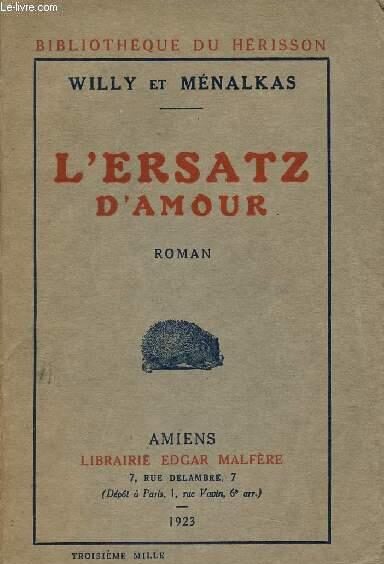
After being dumped by his girlfriend, an professedly heterosexual Parisian musician travels to Germany to find love. Failing to attract a woman, he falls in love with a male German officer over a Wagner concert. When later introduced, he falls in love with the officer’s sister as well. World War I begins and the painter enlists while the officer deserts, stressing their relationship further.
The Replacement of Love in English. The book begins in the summer of 1913 and ends at Christmas 1919. Its sequel is Le Naufrage (1924).
The novel is discussed at length with short translations in Lawrence R. Schehr’s French Gay Modernism (2004).
Editions
- Amiens: Edgar Malfère (1923) seen at Le-Livre on Abebooks.
- Amiens: Edgar Malfère (1935) seen at Le-Livre on Abebooks.
About:
After her son’s death, Madame Casseneuil travels to his apartment and discovers love letters from another man. She meets with his lover and learns to reconcile her disbelief and understand her son.
Editions
-
- Paris: E. Flammarion (1924), 246pp.
- New York : Viking Press (1930), 236pp. Translated by Lady Una Vincenzo Troubridge as Revelation (1930).
- London : Victor Gollancz Ltd (1930), 174pp. Translated by Lady Una Vincenzo Troubridge as Revelation (1930). Dust cover and spine is from Peter Harrington on Abebooks.
There seems to be an additional edition with red binding, unlike the Gollancz’ pure black binding and the black with a red sash binding of the Viking.
Author Details:
Read Now:
About:
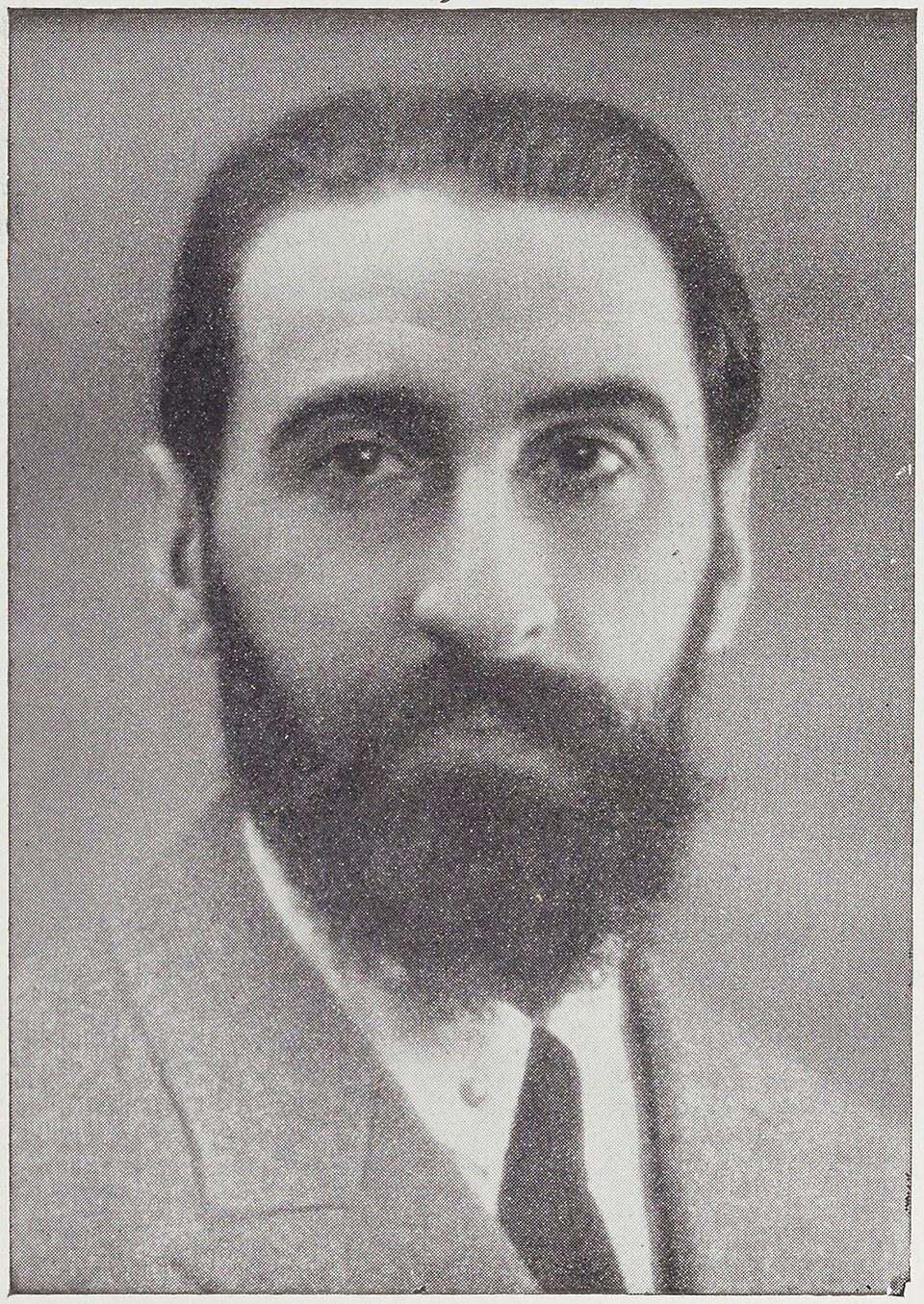
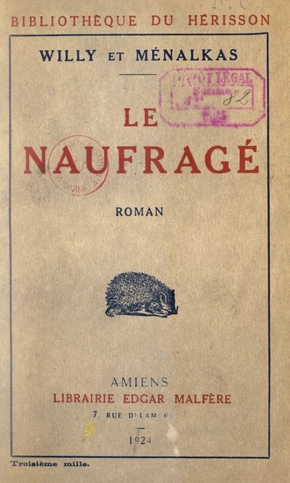
Follows the 1918-1919 German revolution and Carl von Rudorff, who survived the war, looking for the fate of his love, Marc, who did not.
Sequel to Ersatz d’Amour. The Shipwreck in English.
I suspect, like its prequel, this novel is discussed at length with short translations in Lawrence R. Schehr’s French Gay Modernism (2004).
About:
A femme fatale, Iris Storm, and the series of men she seduces and destroys. Her alcoholic brother pushes his love to be the unwitting first of Iris’ doomed husbands after seeing no future in his own romantic relationship with the man.
Also a play in four acts performed at the Broadhurst Theatre, New York, NY. Sep 15 1925-Feb 1926.
Adapted to film as A Woman of Affairs (1928) and Outcast Lady (1934).
Editions
- New York : George H. Doran (1924) 350pp.
- London : W. Collins Sons & Co (1924) 329pp.
Content & Trigger Warnings
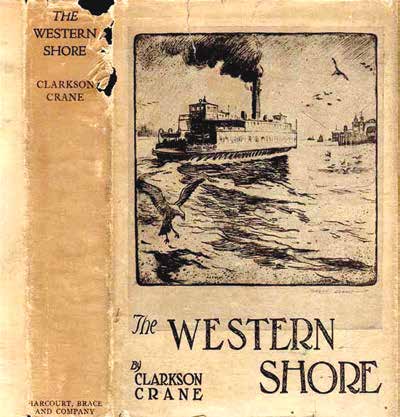
About:
A post-war novel set in 1919 which includes a gay English professor at Berkeley, the same school the author attended before serving in the Ambulance Corps in WWI.
Also see:
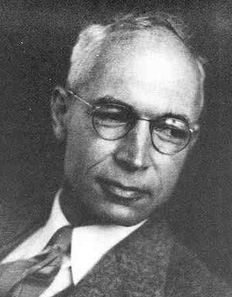
- “Clarkson Crane: Gay San Francisco Between the World Wars.” by Dr. Bill Lipsky. San Francisco Bay Times.
Author Details:
Read Now:
About:
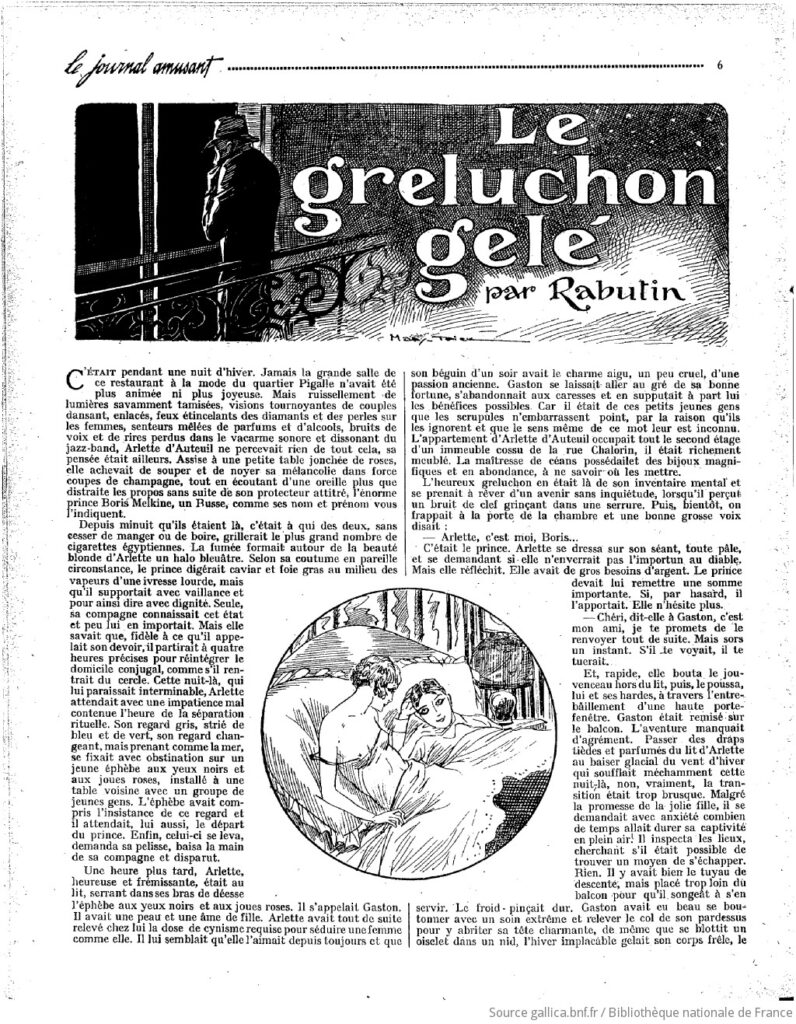
After a woman and her male lover part ways for the night, she invites another man into her bed out of boredom. When the first man returns, she forces the second to hide on the freezing balcony. However, her lover goes to the balcony, invites the freezing man to his own chambers, and departs with him.
Published in Le journal amusant (March 14, 1926) Volume 39, No. 357, pages 6-7. Illustrated by MARS-TRICK.
About:
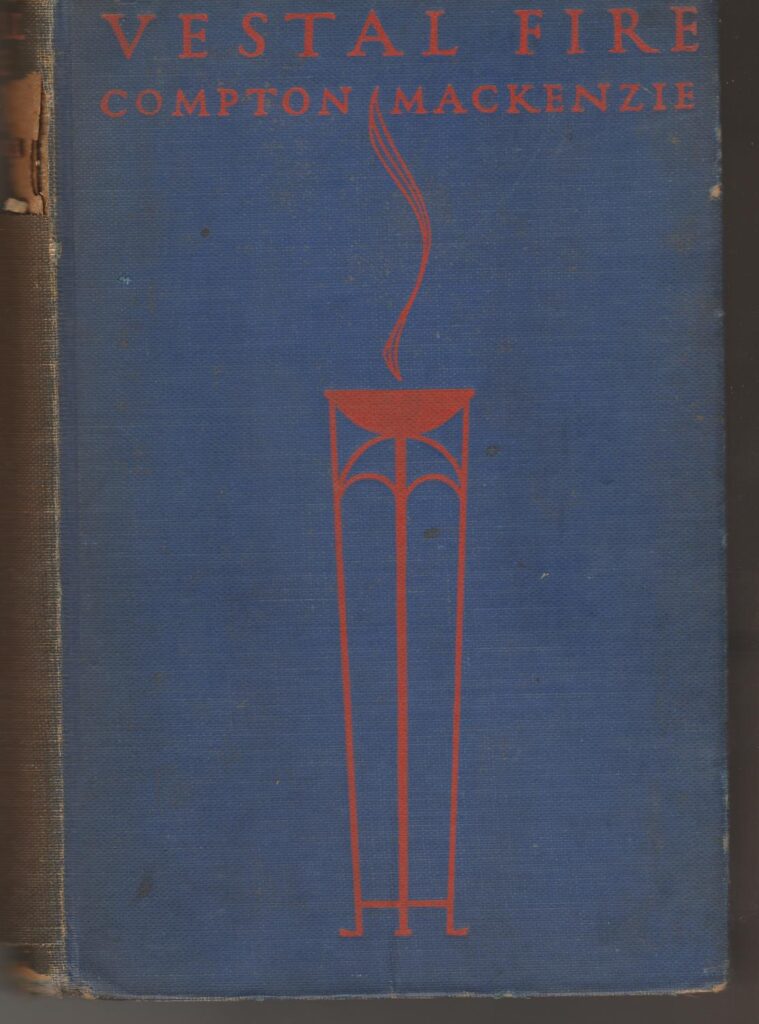
Set in the fictional island of Sirene, based on Capri, where Mackenzie lived from 1913-1914 while writing another novel. Lesbians, gay men, and artists populate the island.
Editions
- London : Cassell & Company (1927)
- New York : George H. Doran Company (1927)
- London : Cassell & Company (1929) pocket edition cover and dustjacket seen at Worthpoint.
Author Details:
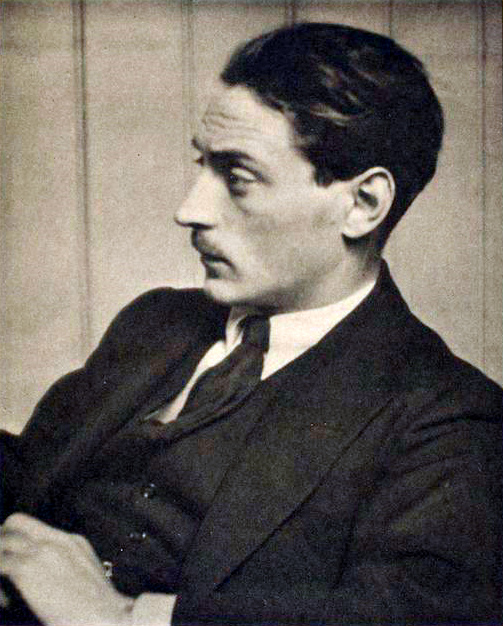
About:
A collection of updated and new musical criticism, essays, and related literature. Privately printed in 133 numbered and signed copies. The copy I referenced from the New York Public Library is number 96.
Contents
“Overture”
“(‘As If……’)”
“Long-Haired Iopas: A Reconstruction”
Dedicated to Harry Harkness Flagler. A character study of Iopas from Vergil’s Aeneid, and, by extension, a celebration and analysis of all musicians.
“After Hearing ‘Don Giovanni'”
“Four Musical Sons Of Vienna”
“Prince Bedr’s Quest”
Dedicated to Mary Severn Perry. A narrative interpretation of Beethoven’s 9th symphony shared between an unnamed speaker and his friend Oswald—almost certainly referring to the protagonists of Imre: A Memorandum (1906). Prince Bedr of Persia believes he is in possession of complete happiness until a dervish encourages him to seek true happiness. Bedr journeys to find the answer—seeing happiness in life, nature, companionship, and the love of a princess—but is finally guided to the truth: God as the source of existence and tandem joy in all the universe.
“(On the Nibelungen Tetralogy: I-II)”
“Wagner As Fabulist And Realist”
Originally published as “Wagner as Fabulist and Realist” (Feb 22, 1900) in The Independent.
“(On the Nibelungen Tetralogy: III-IV)”
“The Illogical Wagner”
Dedicated to Xavier Mayne. A critique of Wagner’s Tetralogy and other works as clumsy, contradictory, and unworthy of their wide praise.
“Where the Mastersingers Sang”
“The Wagnerian Dragon”
Originally published as “The Wagnerian Dragon” (Feb 11, 1899) in Harper’s Bazaar.
“Bayreuth: Performances and Promises”
“A Star Sets: Max Alvary (♱ 1898)”
“≪Parsifal in New York?≫”
Originally published as “Parsifal in New York?” (Dec 17, 1903) in The Independent.
“(From An Address By Gaetano Negri, 1892)”
“The Unfamiliar “Il Trovatore””
“Verdi: And Theme-Structure of “Aida””
“Italian “Stile Nuovo” In Opera”
“(French Music …. Nationalist In Art)”
“Gounod’s “Faust” Considered Thematically”
Possibly originally published as “Thematic and Other Significances in Gounod’s ‘Faust'” (Mar-Apr 1896) in Music: A Monthly Magazine. Part 1. Part 2.
“Gounod’s “La Rédemption.” And Of Biblical Oratorios”
“Four Current Opera-Writers: De Lara, Massenet, Mancinelli, Goldmark”
“(Violinismo)”
“Women And The Violin: Lady Hallé (Wilda Neruda): “The Grand Style.”
“Chopin”
Expanded from “Frederick Chopin” (Oct 26, 1899), originally published in The Independent. Dedicated to Vernon Lee. A lauding summary of Chopin as a genius who championed the piano to greater affect than any other musician. Prime-Stevenson argues that Chopin has not been succeeded as a pianist, then summarizes Chopin’s influences and artistic traits. An anecdote about Chopin’s temper by a former pupil concludes the essay.
“Moritz Rosenthal, Emil Sauer: And Modern Pianism”
“The Patent Virtuoso”
“Speaking-Actors And Singing-Actors”
Originally published as “Speaking-Actors and Singing-Actors” (Jan 26, 1899) in The Independent.
“A Fairy-Tale Untold: Rubinstein — A Last Look”
“Imagination and Realism In Magic: Richard Strauss.”
Excerpt published in Disques (Sep 1932).
[Further contents unavailable.]
Also see:
About:
A set of essays describing the history and merits of queer love, specifically geared towards the Hellenic understanding of pedophilia.
Written by Edward “Ned” Perry Warren as Arthur Lyon Raile.
Published in three parts, each a separate volume:
- Part 1: Preface. The Boy-Lover (1928) — 134 pages
- Part 2: Uranian Eros (1930) — 166 pages
- Part 3: The Heavenly Wisdom. Conclusion. (1928?)— 81 pages
Author Details:

About:
Follows a young man’s loves and affairs, his attempts to love women and join the church, and eventually his acceptance of his sexuality.
Generally The White Page or A White Paper in English. Although published anonymously, it is illustrated with a preface by Jean Cocteau, whose authorship was later confirmed.
Editions
- Paris : M. Sachs et J. Bonjean (1928) in 31 copies, 10 reserved for the author. Printed on Montval laid paper, handmade by Gaspard Maillol, by Ducros et Colas, printers, Paris.
- Paris : The Olympia Press (1957)
- New York : The Macaulay Company (1958)
- London : Peter Owen (2013) edition was issued for the 50th anniversary of Cocteau’s death. Translated by Margaret Crosland.
About:
A set of homoerotic poems published closely after Birch’s graduation from Shrewbury.
Editions
- Cambridge : Corydon Press (c1929). 250 copies, 230 for sale.
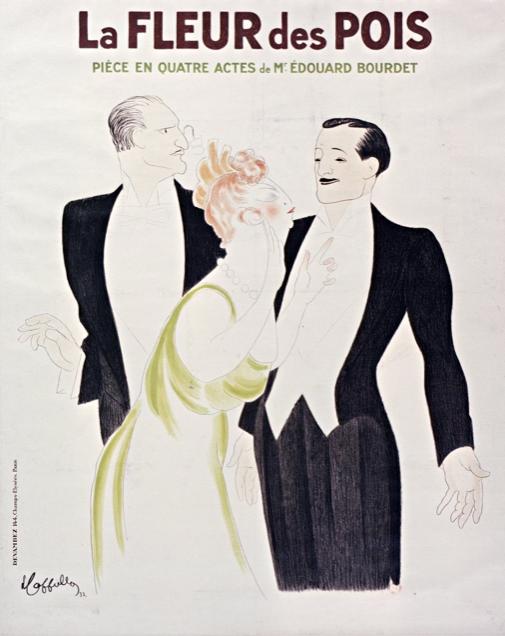
About:
After his business falls on hard times, an automobile dealer garners interest in himself and brand by visiting social salons in outrageous personalities—the “Duke” and “Marie-Chantal”—embodying gay tropes.
Debuted on October 3, 1929 at the Michodière theatre following a few replacement of actors and the staging director. Adapted in 1975 as a film by Raymond Rouleau.
The title is a phrase meaning “an elegant person,” and is translated as “The Snobs” in A History of Homosexuality in Europe, Vol. I & II: Berlin, London, Paris; 1919-1939 (2000) by Florence Tamagne
Also see:
- Part 6 of Régie Théâtrale’s biography of Bourdet by Genevieve Latour.
- Stage details and set design at Régie Théâtrale
Editions
- Paris : Stock (1932)
- Paris : Stock (1933) 254pp. Green cloth-bound hardcover with title stamped in gold atop black spine label. Top edge gilt.
- Paris : Stock (1933) paperback

Read Now:
About:
The protagonist, a woman trapped in a lifeless marriage, observes a crowd of city folks stranded in her tiny German town. The group of actors, a boxer, and others mingle with the locals. One, a heterosexual actress, remains under the care of a local lesbian to whom she is unable and unwilling to return the affections of. She instead recounts stories of other lesbians to her, bringing in contrasts of female sexuality and independence.
Also see:
- Best-sellers by Design: Vicki Baum and the House of Ullstein (1988) by Lynda J. King (ISBN: 978-0814320006)
- Women and Modernity in Weimar Germany: Reality and Its Representation in Popular Fiction (2001) by Vibeke Rützou Petersen, Vibeke Petersen Gether (ISBN: 978-1571811547)
- Queer Identities and Politics in Germany: A History, 1880–1945 (2016) by Clayton J. Whisnant (ISBN: 978-1939594105)
Other Editions
- Berliner Illustrirte Zeitung (Aug 17-Nov 16, 1930) Serialization
- Berlin : Ullstein (1930) 322pp.
- London: Geoffrey Bles (1931) 315pp. Tr. Margaret Goldsmith as Results of an Accident.
- Garden City, NY : Doubleday (1932) 320pp. Tr. Margaret Goldsmith as Life Goes On.
- New York : Grosset (1933)


About:
A study of narcissism which follows a gigolo who shares an apartment with a gay man—a Broadway singer—in New York
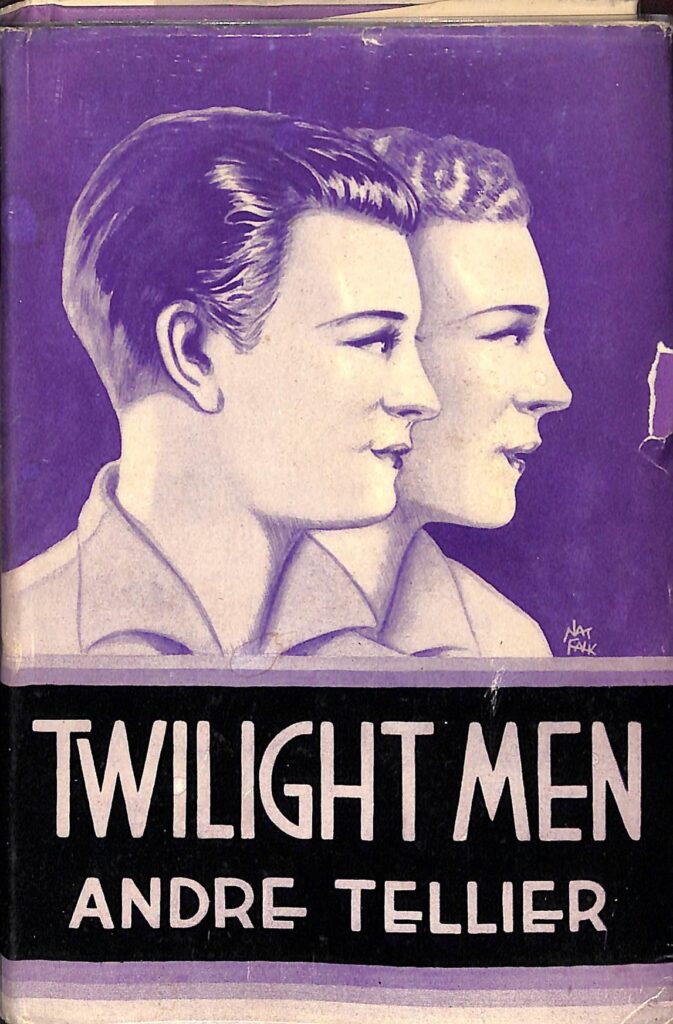
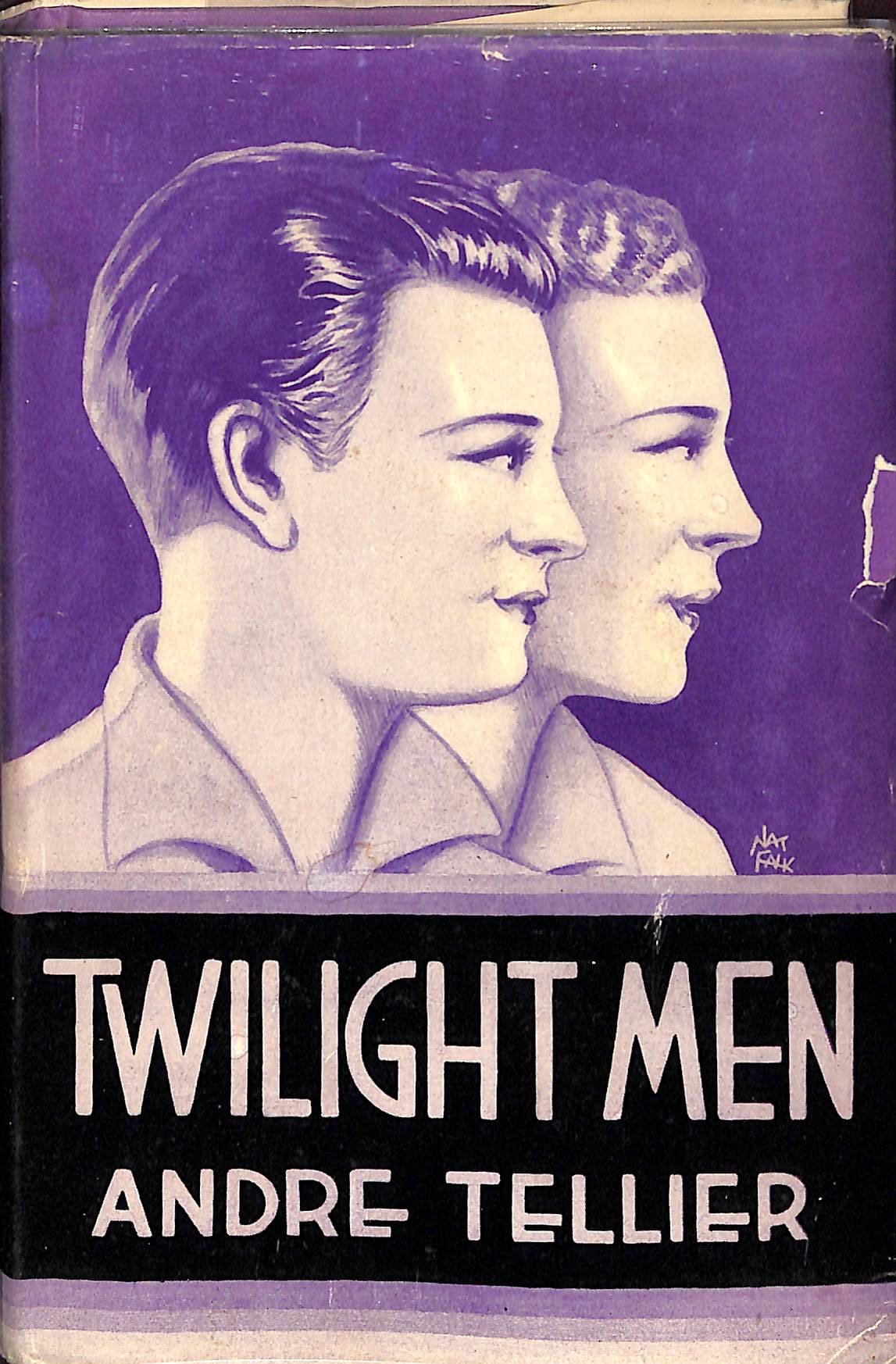
About:
After the deaths of two loves, Armand moves from France to face New York City and self-discovery. A woman hired by his acrimonious father tails him, although her attempts to seduce him break way to a unrequited infatuation. After Armand drifts through the city, he finally finds community in the artistic queer scene, where he receives support as a poet and as a man who loves other men. However, the nights of drinking, drugs, and naivete drag him into ruin.
André Tellier’s second novel.
Later prints as a pulp helped secure the novel’s reputation as a clichéd and dramatic story of the queer experience.
Editions
- New York : Greenberg (1931). 338pp.
- London : T. Werner Laurie Ltd. (1933). 296pp. Expurgated text.
- New York : Greenberg (1948). 251pp. Revised text. All subsequent editions use this text.
- New York : Lion Books (1950). 251pp. First pulp edition.
- Milan : Garzanti (1951). 225pp. Translated to Italian as Uomini del Crepuscolo by Vincenzo Loriga.
- New York : Pyramid Books (1957). 224pp. Contains six illustrations.
Also see:
Author Details:
About:
Prinz Friedrich von Tegen, a loyal and practical statesman, acts alongside the suave Russian spy Boris Serevitch to preserve the Austria through the war. Threatened by counter spies and power-hungry nobles, they lie their way through intrigue, rebellion, and the scathing romances left behind.
Andre Tellier’s third and final novel.
Editions
- New York : Greenberg (1931). 323pp.
- London : Stanley Paul and Co. (1932) as The Great Intrigue.
Also see:
Author Details:

About:
A moralist man who lost his job wanders Berlin and encounters the range of its immoral inhabitants, including several queer characters. The novel is a realist series of misfortunes and social betrayals as the Nazis begin rising in power.
Kästner’s books, including this one, were among the titles burned in the 1933 Nazi book burnings.
Other Editions
Multiple forewords and and statements have been included over the years. It seems that most or all have been compiled in the 2013 edition.
Editions
- Munich : Deutschen Verlags-Anstalt (1931) Expurgated. Cover by Wikipedia. Spine seen at oldthing.
- London : Jonathan Cape (1932) Expurgated in English as Fabian: The Story of a Moralist.
- Libris (1990) Unexpurgated in English as Fabian: The Story of a Moralist.
- Northwestern Uni Press (1993) Unexpurgated in English as Fabian: The Story of a Moralist. Includes 1952 epilogue. Tr. Cyrus Brooks.
- Zurich : Atrium-Verlag (2013) Unexpurgated as Der Gang vor die Hunde (Going to the Dogs). Restored passages and added appendix detailed at Wikipedia.

Content & Trigger Warnings
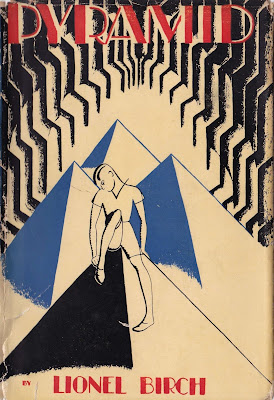
Read Now:
About:
Tony Roreton seeks “the Ideal of the One Perfect Friend” among his classmates. He moves from enchantment to disillusion throughout his attachments to three other boys, and eventually grows to seeks companionship in a woman.
Also see:
- “Lionel Birch” by Robert J. Kirkpatrick.
- “Birch: Lionel ‘Bobby’ Birch 1910-1982” by History of Steep
- J. L. Austin: Philosopher and D-Day Intelligence Officer (2023) by M. W. Rowe, pages 53-54.
About:
A utopian technological novel which champions free sex—this time explicitly including homosexuality into the belief. The protagonist studies and visits different environments, teaching herself and the reader about the symbiosis of differing sexualities, and eventually she enters a relationship with Billy, a woman.
Erna, A Young Girl from Berlin in English.
The novel is discussed at length with short translations in Lawrence R. Schehr’s French Gay Modernism (2004).
Another source says that the book ends with Erna marrying a strictly conservative man who forces her to remain home (A History of Homosexuality in Europe by Florence Tamagne, 54p).