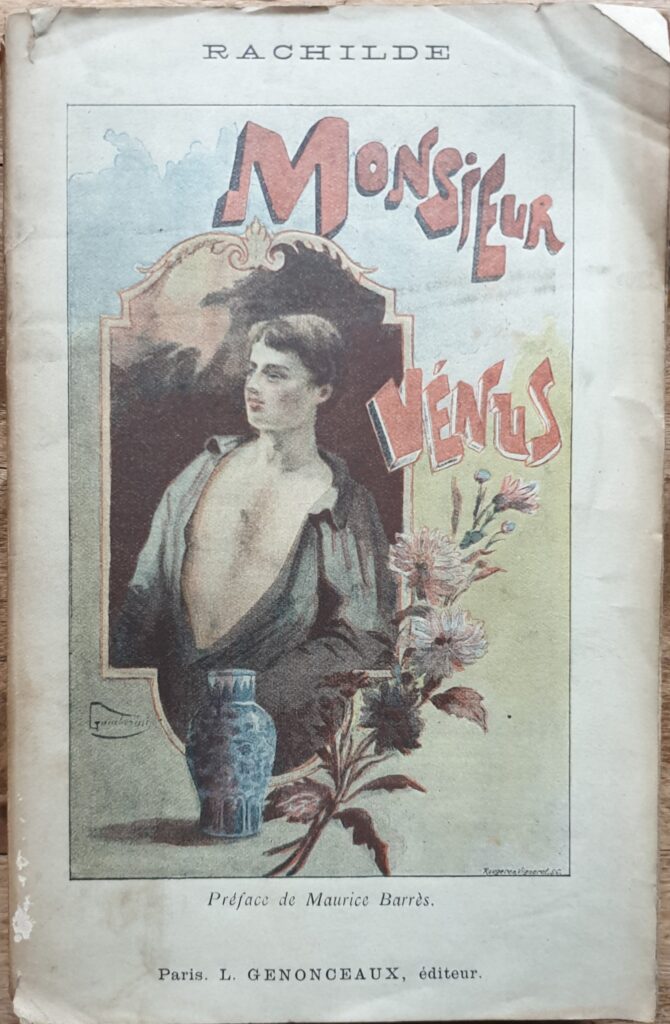
About:
A novel of a woman bored of her life and who pays a poor florist to enter a relationship with her. She taunts and abuses him from an androgynous figure into a feminine one, but when he tries to seduce her rejected male suitor, she organizes a duel which leaves the florist dead. By the end, in interchanging male and female clothes, she embraces a wax doll created to mimic the dead man.
Editions
- Bruxelles : August Brancart (1884) first edition contains the full text. A fictitious co-author named "F. T." is also credited.
- Bruxelles : August Brancart (1884) second edition contains a few deleted words in the final chapter. Contains a preface by Arsène Houssaye. Seen at Livres-émoi on Abebooks.
- Bruxelles : August Brancart (1884) third edition contains further excisions, cutting erotic details in the final chapter and the protagonist's orgasm from a daydream in Chapter 2.
- Paris : Felix Brossier (1889) first edition published in France. Contains all excisions from previous publications plus further cuts, including Chapter 7, where the protagonist asserts that women could destroy men by robbing them of their masculinity through sex. Francis Talman's name as collaborator is also removed. Contains an editor's note and a preface by Maurice Barrès.
- New York : Covici, Friede (1929) first English Edition in 1,200 copies. Translated by Madeleine Boyd from the French edition. Illustrated by Majeska. Contains an introduction by Ernest Boyd and a preface by Maurice Barrès. 217pp. Seen on Worthpoint by Double Eagle Books.
- New York: Modern Language Association of America (2004) reissue of the original 1884 French text under the title Monsieur Vénus: Roman Matérialiste (2004). Edited and introduced (in English) by Melanie Hawthorne and Liz Constable. ISBN: 9780873529297
- New York : Modern Language Association of America (2004) as Monsieur Vénus: A Materialist Novel. Translated to English by Melanie Hawthorne after the 1929 translation by Madeleine Boyd. Introduced and annotated by Melanie Hawthorne and Liz Constable.
Also see:
- "Monsieur Vénus: A Critique of Gender Roles" (1897) by Melanie C. Hawthorne in Nineteenth-Century French Studies (1988), Vol. 16, No. 1, pp. 162-179.
- Ventriloquized Bodies: Narratives of Hysteria in Nineteenth-century France (1994) by Janet L. Beizer (ISBN: 9780801481420)
- Rachilde and French Women's Authorship: From Decadence to Modernism (2001) by Melanie Hawthorne (ISBN: 978-0803224025)
- Before Trans: Three Gender Stories from Nineteenth-Century France (2020) by Rachel Mesch (ISBN: 978-1503612358)